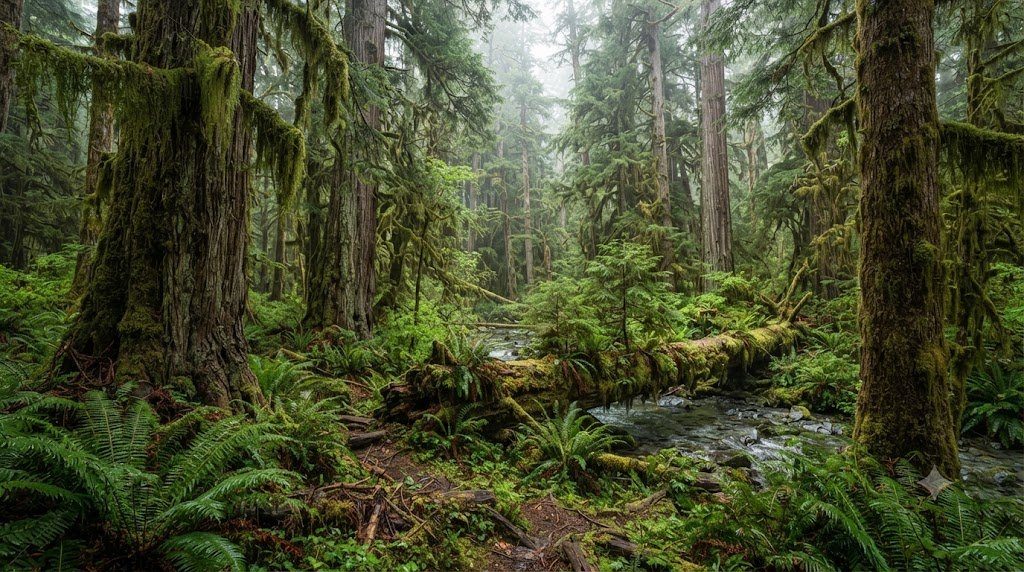
The temperate rainforests of the Pacific Northwest—stretching in a narrow coastal corridor over 2,000 kilometers from northern California through Oregon, Washington, and British Columbia to southeastern Alaska’s Alexander Archipelago—represent the absolute pinnacle of terrestrial biomass accumulation on planet Earth. Operating under cool maritime maritime conditions, mild winters, cool summers, and astonishing precipitation (2,000 to 4,500 mm annually) augmented by dense summer ocean fog drip, these ancient coastal ecosystems harbor the tallest and most massive living organisms in existence. Dominated by structural conifer titans—most famously Coast Redwood (Sequoia sempervirens), Douglas-fir (Pseudotsuga menziesii), Sitka Spruce (Picea sitchensis), and Western Redcedar (Thuja plicata)—PNW temperate rainforests store up to 1,000 to 1,500 metric tons of carbon per hectare, far exceeding the carbon density of tropical Amazonian rainforests. Analyzing fog interception mechanics, epiphytic bryophyte biomass, nurse log seedling regeneration, and salmon-derived marine nitrogen subsidies is vital for old-growth conservation.
The Maritime Fog Drip Phenomenon and Summer Drought Survival
Although Pacific Northwest temperate rainforests receive immense precipitation during autumn and winter, they experience severe 2- to 3-month summer droughts. Coast Redwoods survive this summer dry period through fog drip interception. Cold Pacific ocean upwelling generates dense summer advection fog banks that roll inland. As fog blows through redwood canopies over 100 meters tall, needles condense microscopic water droplets that coalesce and rain down onto the forest floor, supplying up to 30% to 40% of the tree’s entire annual water budget and maintaining soil moisture through blistering summer days.
1. Geographic Extent and Coastal Coniferous Giants
The Pacific Northwest temperate rainforest is home to conifers that reach structural dimensions unmatched anywhere else in the plant kingdom:
- Coast Redwood (Sequoia sempervirens): The tallest trees on planet Earth, restricted to a narrow 750-km coastal fog belt from Monterey County, California, to southwestern Oregon. Specimens regularly exceed 100 to 115.8 meters (380 feet) in height, with trunk diameters of 6 to 9 meters and lifespans surpassing 2,000 years. Bark is thick (up to 30 cm), fibrous, and laden with fire-resistant tannins.
- Coast Douglas-fir (Pseudotsuga menziesii var. menziesii): Massive pioneer and long-lived seral dominant reaching 80 to 100 meters tall, with deeply furrowed, corky bark up to 20 cm thick that provides exceptional resistance to surface wildfires.
- Sitka Spruce (Picea sitchensis): Occupies the immediate ocean spray belt within 5 km of the coast. Highly tolerant of ocean salt spray and high winds, reaching 70 to 90 meters tall with massive fluted bases on wet alluvial terraces.
- Western Redcedar (Thuja plicata): The ‘Tree of Life’ of Pacific Northwest indigenous coastal cultures. Reaches trunk diameters exceeding 6 meters, with rot-resistant wood containing natural antifungal thujaplicins, thriving in water-saturated valley bottoms.
2. Comparative Conifer Dimensions and Biomass Density Benchmarks
Comparing the premier coniferous titans of the Pacific Northwest illustrates the staggering structural scale of these ancient old-growth forests:
3. Nurse Logs: The Fallen Giants Fueling Forest Regeneration
On the floor of an ancient Pacific Northwest rainforest, regenerating tree seedlings face a severe physical obstacle: the ground is smothered by an impenetrable blanket of mosses, liverworts, and decaying needles up to 30 cm thick. Overcoming this barrier relies on nurse logs:
The Nurse Log Succession Cascade
When a massive 500-year-old Sitka spruce or Douglas-fir falls, it takes 200 to 400 years to decompose. As the bark sloughs off, airborne seeds of Western Hemlock and Sitka Spruce land on the elevated log surface. The nurse log provides three critical survival advantages: 1. Elevated Light: It lifts tiny seedlings above the dark moss and herbaceous understory; 2. Moisture Sponge: The rotting wood absorbs water like a sponge, staying moist during summer droughts; 3. Pathogen Escape: It isolates seedlings from damping-off soil fungi on the ground. As seedlings grow, their roots wrap around the circumference of the log and penetrate the mineral soil below. Centuries later, when the nurse log finally rots away completely, mature hemlocks stand in striking straight lines, supported on eerie ‘stilt roots’ with open spaces beneath their trunks.
4. Epiphytic Bryophyte Mats and Canopy Ecosystems
The canopy of an old-growth PNW rainforest is an aerial continent of suspended organic matter. Massive horizontal branches support colossal carpets of epiphytic mosses (such as Hylocomium splendens and Isothecium stoloniferum), liverworts, and the Licorice Fern (Polypodium glycyrrhiza):
In coastal valleys like Washington’s Olympic Peninsula Hoh Rainforest, epiphytic bryophyte biomass can weigh up to 10 to 18 metric tons of dry matter per hectare—up to four times the total weight of foliage on the host trees themselves! These moss mats act as colossal atmospheric moisture interceptors, absorbing rainfall and fog and slowly releasing it during dry weeks. Within these elevated moss beds, canopy soil layers support specialized invertebrate communities, arboreal salamanders (Aneides vagrans), and the endangered Marbled Murrelet (Brachyramphus marmoratus), an oceanic seabird that nests exclusively on thick, moss-covered old-growth conifer limbs.
5. The Salmon-Forest Connection: Marine-Derived Nitrogen Subsidies
One of the most extraordinary ecological discoveries in modern ecology is that the massive old-growth trees of the Pacific Northwest are chemically fertilized by the ocean through migrating anadromous Pacific Salmon (Oncorhynchus species):
Salmon spend 2 to 5 years feeding in the nutrient-rich North Pacific Ocean, accumulating marine biomass before migrating upstream into coastal rivers to spawn and die. Apex terrestrial carnivores—predominantly Grizzly Bears (Ursus arctos), Black Bears (Ursus americanus), and Bald Eagles—catch millions of spawning salmon, dragging carcasses up to 100 to 200 meters into the surrounding forest to feed on energy-rich brain and roe. Over 50% to 70% of each fish carcass is left on the forest floor to decompose.
Stable isotope analysis tracking Nitrogen-15 ($^{15}N$)—which is naturally enriched in marine ecosystems—reveals that up to 20% to 25% of all total nitrogen in the wood and foliage of old-growth trees bordering salmon streams is marine-derived! The ocean feeds the salmon, the salmon feed the bears, and the bears fertilize the colossal trees whose roots stabilize the riverbanks and whose fallen trunks create the pristine gravel pools required for the next generation of salmon.
6. Carbon Sequestration Super-Sinks: High Biomass Density
Old-growth temperate rainforests store more carbon per unit area than any other ecosystem on Earth, outperforming tropical forests:
- Continuous Year-Round Carbon Assimilation: Mild coastal maritime winters mean temperatures rarely drop far below freezing for extended periods. Whenever winter days exceed 5°C, evergreen conifers continue to photosynthesize and assimilate carbon while deciduous forests and boreal trees are dormant.
- Centuries of Structural Carbon Accumulation: Trees live for 500 to 2,000+ years without experiencing stand-replacing wildfires due to cool maritime fog, packing carbon into giant heartwood trunks that resist rot for centuries.
- Massive Coarse Woody Debris Pools: Fallen logs (nurse logs) and standing dead snags constitute up to 30% of total forest carbon, releasing carbon into mineral soils at exceptionally slow rates over multiple centuries.
7. Threats: Industrial Clearcutting and Second-Growth Monocultures
Over 80% to 90% of original old-growth temperate rainforests have been logged over the past 150 years, converted into even-aged industrial timber tree farms:
Second-growth plantation forests—typically dense monocultures of Douglas-fir planted after clearcutting—enter a dark, biologically sterile ‘stem exclusion stage’ between 25 and 80 years of age. Without canopy gaps, nurse logs, multi-tiered structural layers, or broadleaf understories, second-growth stands support less than a fraction of the biodiversity found in ancient forests. Modern conservation focuses on protecting remaining old-growth remnants, decommissioning logging roads that cause erosion into salmon streams, and practicing variable-density thinning to accelerate the development of old-growth characteristics in young plantation forests.
8. The Epiphytic Lichen Canopy: Lobaria oregana and Nitrogen Fixation
Perched in the sunlit upper canopy of ancient Douglas-fir and Sitka spruce trees is a massive biomass of specialized epiphytic lichens, most prominently Lobaria oregana (the Lettuce Lichen):
- Tripartite Actinorhizal Symbiosis: Lobaria oregana is a tripartite lichen consisting of an ascomycete fungus, a green alga, and specialized cyanobacterial internal chambers (cephalodia) containing Nostoc. The cyanobacteria actively fix atmospheric dinitrogen ($N_2$) into ammonium ($NH_4^+$) high in the tree branches.
- The Canopy Nitrogen Rain: In an old-growth forest, Lobaria biomass can exceed 500 to 1,000 kilograms per hectare. During winter gales, fragments of lichen tear free and fall to the forest floor. As they decay, they release 5 to 10 kilograms of bioavailable nitrogen per hectare annually, acting as the primary natural atmospheric fertilizer sustaining forest soil fertility without external chemical inputs.
- Extreme Sensitivity to Forest Fragmentation: Because Lobaria reproduces via heavy, non-motile vegetative soredia and lacks protective cuticles, it cannot survive in dry second-growth tree farms or near clearcut edges. Its presence is an obligate ecological bioindicator of undisturbed, ancient old-growth interior microclimates.
9. Fire Regimes: Low-Frequency Mixed-Severity Oceanic Regimes
Unlike dry interior pine forests that burn every 10 to 25 years, the fire regime of coastal Pacific Northwest temperate rainforests is characterized by extreme long-return intervals (ranging from 250 to 800+ years):
During standard summers, marine fog and high fuel moisture make wildfire ignition virtually impossible. Only during rare, extreme synoptic weather events—characterized by multi-year megadroughts combined with hot, dry, easterly offshore foehn winds blowing down from the Cascade Mountains—can stand-replacing wildfires ignite. When fires do occur, they burn at mixed severities: mature thick-barked Douglas-firs and Coast Redwoods survive with charred trunks, while thinner-barked hemlocks and true firs succumb, creating structural structural heterogeneity that resets multi-century forest succession.
10. Frequently Asked Questions Regarding PNW Temperate Rainforests
Q: Why do the tallest trees in the world grow in the Pacific Northwest?
The combination of mild maritime winters, abundant precipitation, cool summer fog drip that prevents drought stress, and absence of frequent high-intensity wildfires allows trees to live for thousands of years and reach immense heights.
Q: What is a nurse log and why is it essential for forest regeneration?
A nurse log is a large fallen tree trunk that provides an elevated, moist, nutrient-rich platform free of dense ground moss and soil pathogens where hemlock and spruce seeds can germinate and grow.
Q: How does summer ocean fog help Coast Redwoods survive dry months?
Fog droplets condense on high redwood needles and drip down to the forest floor, supplying up to 30% to 40% of the tree’s entire annual water needs and keeping soil moist during summer rainless periods.
Q: How do migrating salmon fertilize old-growth forests?
Bears and eagles drag salmon carcasses into the forest to eat. Decomposing fish release marine-derived nitrogen (15N) and phosphorus into the soil, accounting for up to 25% of the nitrogen in streamside trees.
Q: Why do temperate rainforests store more carbon than tropical rainforests?
Temperate conifers live much longer (up to 2,000+ years), grow much larger trunks, experience cool temperatures that slow decomposition, and photosynthesize year-round during mild maritime winters.
Q: What is stilt-rooting in Western Hemlock trees?
Stilt-rooting occurs when a hemlock seedling grows on top of a fallen nurse log. The roots wrap around the log into the ground; when the log rots away centuries later, the mature tree is left standing on elevated, stilt-like roots.
Q: What endangered seabird nests high in the old-growth rainforest canopy?
The Marbled Murrelet is a pelagic seabird that flies up to 50 miles inland to lay a single egg on wide, moss-covered branches of ancient conifers, completely dependent on old-growth forests.
Q: Why are second-growth timber plantations less biodiverse than old-growth forests?
Tree farms are even-aged monocultures with dense, dark canopies that block light to the forest floor, lacking the multi-tiered structure, snags, nurse logs, and ancient epiphyte mats found in old-growth forests.
Q: What role does Lobaria oregana lichen play in the old-growth canopy?
Lobaria oregana contains symbiotic cyanobacteria that fix atmospheric nitrogen high in tree branches. When lichen pieces fall and decay, they fertilize forest soils with up to 10 kg of nitrogen per hectare annually.
Q: How thick can the fire-resistant bark of an ancient Coast Redwood grow?
The fibrous, tannin-rich bark of a mature Coast Redwood can reach a staggering 30 centimeters (12 inches) in thickness, protecting the internal vascular cambium from surface wildfires.