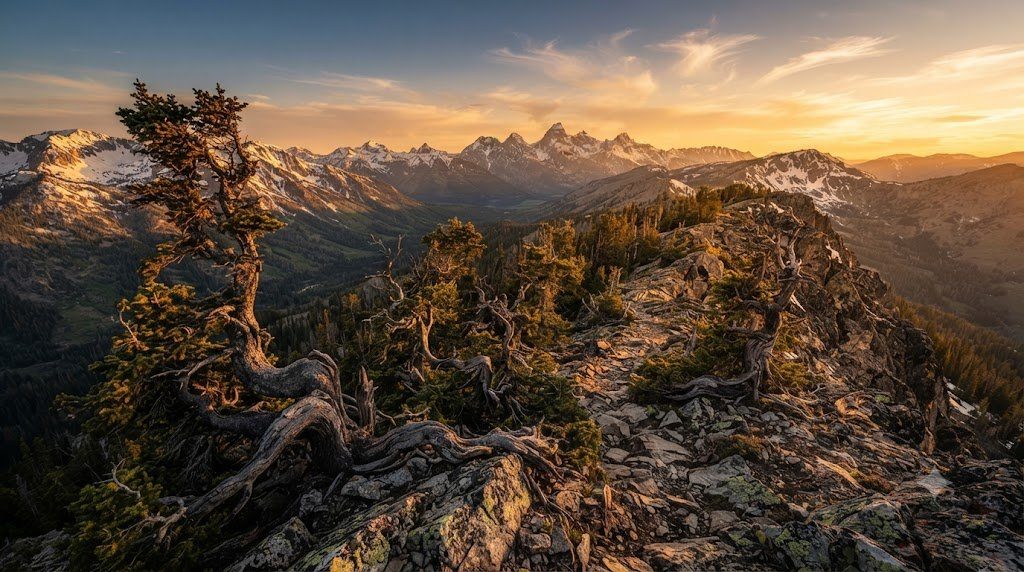
The subalpine treeline ecotone—the dramatic transitional boundary zone separating continuous subalpine closed-canopy forests from open alpine tundra—represents one of the most visually striking and biologically intense ecological frontiers on planet Earth. Within this narrow vertical belt, towering forest conifers succumb to severe environmental stress, transforming into the iconic, dwarfed, wind-sculpted growth form known globally by the German term Krummholz (meaning ‘crooked or twisted wood’). Dominated across the Northern Hemisphere by Engelmann Spruce (Picea engelmannii), Subalpine Fir (Abies lasiocarpa), Bristlecone Pine (Pinus longaeva), and Swiss Stone Pine (Pinus cembra), krummholz formations endure brutal winter gale-force winds, blowing ice-crystal abrasion, severe needle cuticular desiccation, and truncated growing seasons. Investigating the thermal mechanisms governing treeline limits, wind-flagging biomechanics, and the epic longevity of high-altitude bristlecone pines provides critical insights into mountain ecosystem dynamics.
The Global 6.7°C Root-Zone Thermal Treeline Limit
For centuries, naturalists debated whether treeline is caused by high wind, snow depth, or thin soils. Landmark global ecophysiological research by Christian Körner established that the alpine treeline is governed worldwide by a universal thermal limitation: the minimum root-zone temperature threshold. Across all latitudes from the Arctic to the tropics, trees cannot form upright woody trunks if the mean soil temperature at 10 cm depth during the growing season drops below 6.7°C (44°F) for fewer than 94 days. Below this thermal limit, meristematic cell division and xylem lignification are biochemically halted, preventing upright tree growth.
1. Anatomical Zonation: The Structural Ecotone Gradient
The transition from forest to tundra is rarely a sharp line; rather, it is a multi-tiered structural gradient spanning 50 to 200 vertical meters:
- 1. The Continuous Forest Limit (Timberline): The upper elevation limit of closed-canopy subalpine forest, where upright trees stand closely spaced, canopy cover exceeds 40%, and trees attain heights of 15 to 25 meters.
- 2. The Treeline Proper (Tree Limit): The upper elevation limit of individual upright arborescent trees reaching at least 2 to 3 meters in height, growing in open, park-like groves or scattered ribbon forests.
- 3. The Krummholz Zone (Combat Zone / Kampfformen): The extreme upper limit of tree species, where environmental stresses prevent upright growth. Trees survive solely as dense, sprawling, prostrate mats or stunted shrub-like thickets hugging the ground (typically 0.5 to 1.5 meters tall).
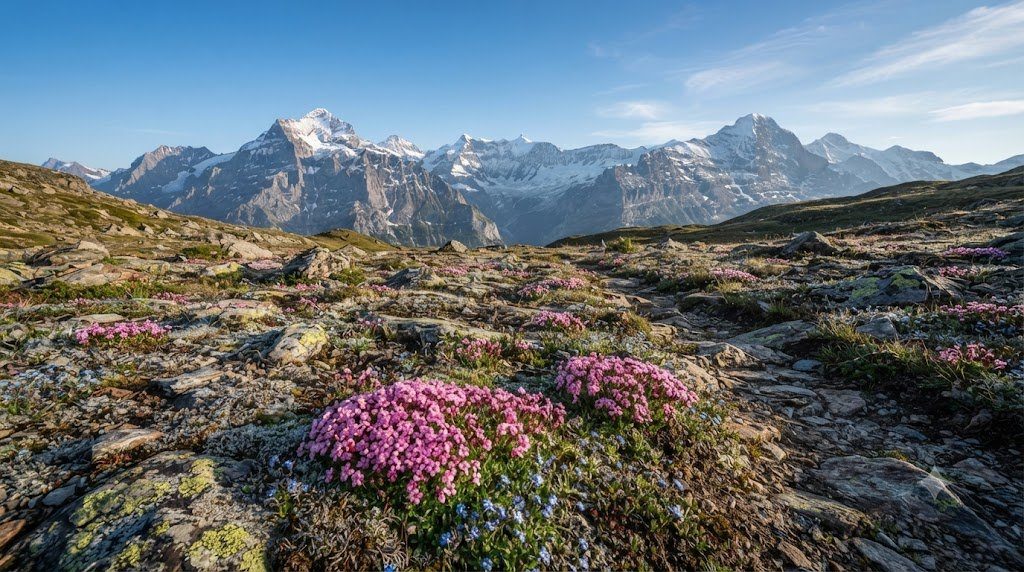
- 4. The Alpine Tundra Boundary: The complete disappearance of woody tree species, where only herbaceous sedges, dwarf shrubs, and cushion plants can survive.
2. Ice-Particle Sandblasting and Wind Flagging Biomechanics
In the harsh krummholz ecotone, winter winds blowing across ridges frequently exceed 120 to 180 km/h, carrying hard, wind-driven ice crystals that act like high-velocity sandpaper:
The Anatomy of Flagged and Cushion Krummholz
When winter wind blows persistently from a single direction, trees develop asymmetrical flagged trees (Bannerbäume). Branches on the windward side are stripped of bark and needles by blowing ice crystals; winter wind desiccates exposed buds before spring. Conversely, branches on the protected leeward side survive and grow, producing trees with branches pointing entirely in one direction, like a weather vane. When wind stress is even more severe, trees form prostrate cushion mats: terminal leader shoots that try to grow above winter snowpack height are repeatedly killed by wind and ice, forcing the tree to grow horizontally along the ground through vegetative layering.
3. Winter Cuticular Desiccation and Freeze-Thaw Embolism
The primary killer of conifer needles at the subalpine treeline is not freezing cold per se, but winter cuticular transpiration desiccation:
Due to cold, short summer temperatures, conifer needles at the treeline often do not have enough thermal time to fully mature a thick, protective wax cuticle before autumn arrives. During sunny, windy winter days, high solar radiation warms exposed needles above freezing, stimulating water vapor loss through the incomplete, thin cuticle. However, the tree’s trunk and root zone remain frozen solid in sub-zero soil; the tree cannot replace transpirational water. Within weeks, the needles dehydrate, turn rusty red, and die—a syndrome known as winter browning (winter desiccation).
4. Great Basin Bristlecone Pines (Pinus longaeva): Millennia of High-Altitude Survival
Perched at the treeline in the arid White Mountains of California and Nevada sits the oldest non-clonal living organism on Earth: the Great Basin Bristlecone Pine (Pinus longaeva):
Bristlecone pines grow at an astonishingly slow rate—often adding less than 1 inch of trunk girth per century. Their dense, amber-colored wood is packed with antifungal terpenes and resin. Even when a tree dies, its dead skeleton stands rock-solid on the subalpine ridge for 3,000 to 5,000 years without rotting, polished smooth by centuries of blowing ice and wind.
5. Vegetative Layering: Clonal Propagation Under Extreme Cold
Because cold temperatures and short seasons at the krummholz limit severely suppress viable seed production, conifers rely heavily on asexual vegetative layering:
Heavy winter snowpacks pin lower branches of Subalpine Fir and Engelmann Spruce flat against the ground. Covered in moist moss and needles, the pinned branch develops adventitious roots into the mineral soil. Over decades, this branch turns upward into an independent vertical trunk. Through continuous layering, a single genetic individual (clone) forms an expansive, interconnected krummholz island that can persist for thousands of years, creeping slowly across the landscape.
6. Climate Change Impacts: Treeline Advance and Shifting Ecotones
As global mountain temperatures climb, subalpine treeline ecotones are undergoing dramatic structural transformations:
Warming soil temperatures are crossing the 6.7°C root-zone threshold at higher elevations, allowing krummholz mats to sprout vertical leader shoots and transform into upright trees. Tree seedlings are establishing successfully in alpine tundra hundreds of meters above current timberlines. However, this upward advance is not uniform: in arid mountain ranges (like the American Southwest), rising temperatures are accompanied by severe summer droughts that kill young seedlings, causing treelines to retract downward rather than advance.
7. Dendrochronology: High-Altitude Trees as Climate Archives
Because tree growth at the subalpine treeline is strictly controlled by a single dominant limiting factor—summer temperature—krummholz and bristlecone pines serve as the premier natural instruments for dendroclimatology:
- Annual Ring Width as Paleotemperature Thermometers: In warm summers with long growing seasons, trees form wide annual rings of light-colored earlywood and dense latewood. In freezing summers or volcanic cooling years, rings shrink to microscopic single-cell widths or fail to form altogether (missing rings). Scientists measure microscopic tree-ring widths to reconstruct continuous global temperature records stretching back over 9,000 years.
- Frost Rings as Volcanic Eruption Signatures: When sudden unseasonal summer freezing events strike (such as following monumental historical volcanic eruptions that pump sulfate aerosols into the stratosphere), living xylem cells that are actively dividing freeze and rupture, forming permanently deformed, collapsed cellular bands known as frost rings. These frost rings provide exact calendar-year markers for ancient eruptions like Santorini (1628 BCE) and Tambora (1815 CE).
- Radiocarbon Calibration and the IntCal Curve: Ancient dead bristlecone pine wood preserved in the dry desert mountains of California provided the foundational wood samples used to cross-calibrate carbon-14 ($^{14}C$) decay rates, establishing the global radiocarbon calibration curve utilized by modern archaeologists worldwide.
8. Clark’s Nutcracker and the Whitebark Pine Mutualism
Across the high mountains of western North America, the subalpine treeline ecosystem is structurally anchored by an obligate coevolutionary mutualism between Whitebark Pine (Pinus albicaulis) and an avian corvid, Clark’s Nutcracker (Nucifraga columbiana). This keystone relationship demonstrates how wildlife and high-altitude flora are inextricably linked in determining ecosystem resilience and spatial distribution across the treeline ecotone:
Whitebark pine cones are serotinous, heavy, and indehiscent; unlike standard conifers whose cones open readily in autumn dry breezes, whitebark pine cone scales remain tightly sealed with resin and do not open upon maturity. The seeds are wingless, exceptionally dense, and completely incapable of wind dispersal. The species relies almost 100% on Clark’s Nutcracker for sexual reproduction and seed dispersal across broken mountainous terrain.
The nutcracker is anatomically tailored for this mutualism. It possesses a sharp, chisel-like beak capable of cracking thick cone scales and an elastic sublingual pouch beneath its floor of mouth that can hold up to 90 large, energy-dense seeds at a single harvest. During late summer and autumn, a single individual bird can cache between 30,000 and 100,000 seeds across steep mountain ridges, barren scree slopes, and recently burned areas. The bird buries these seeds at a precise depth of 2 to 3 centimeters—the exact optimal depth required for conifer seed germination. While the birds exhibit astonishing spatial memory, retrieving thousands of stored seeds under feet of winter snow, thousands of seeds are inevitably left behind. These forgotten caches germinate in multi-stemmed clusters, founding the next generation of pioneering subalpine forests.
9. White Pine Blister Rust and Mountain Pine Beetle Epidemics
Subalpine treeline conifers are currently experiencing unprecedented ecological collapse across the Rocky Mountains, the Cascades, and the Sierra Nevada from an intense confluence of native and introduced biological pathogens accelerated by anthropogenic warming:
The non-native fungal pathogen White Pine Blister Rust (Cronartium ribicola), inadvertently introduced from Eurasia in the early twentieth century, infects five-needle pines through needle stomata. The fungal hyphae migrate inward through phloem tissues, eventually girdling the branch or main trunk and cutting off nutrient translocation. Once girdled, the cone-bearing crown of mature whitebark and limber pines dies, completely stopping seed production decades before the tree itself collapses.
Compounding this fungal pandemic, climate warming has enabled massive outbreaks of the native Mountain Pine Beetle (Dendroctonus ponderosae) at elevations where freezing temperatures historically prevented their survival. Previously, severe winter lows dropping below -40°C killed over-wintering beetle larvae. With milder winters and longer growing seasons, beetles now complete full reproductive cycles in a single year or exhibit bivoltinism (two generations per year) at high altitudes. Millions of acres of ancient subalpine forests have turned gray and dead within a single decade, radically reducing the supply of fatty, protein-rich pine seeds that serve as a foundational autumn nutrition source for grizzly bears (Ursus arctos horribilis), red squirrels, and high-altitude birds preparing for extreme winter survival.
10. Management and Conservation Strategies for Treeline Forests
Conserving fragile treeline ecotones against rapid climatic shifts requires proactive ecological intervention rather than passive wilderness preservation. Conservation biologists are currently executing targeted restoration programs focused on the following key pillars:
- Identifying Genetic Rust Resistance (Plus-Trees): Forestry researchers actively survey dead and dying stands to locate rare, healthy “plus-trees” that exhibit innate phenotypic resistance to white pine blister rust. Seeds from these parent trees are cultivated in specialized nurseries to produce rust-resistant seedlings for high-elevation outplanting.
- Pheromone Trapping and Verbenone Protection: To protect irreplaceable ancient bristlecone and whitebark seed-bearing trees from mountain pine beetle attack, arborists staple slow-release pouches containing verbenone (an anti-aggregation pheromone) to tree trunks. The chemical signal falsely indicates to flying beetles that the tree is already fully occupied, diverting them away from critical mother trees.
- Assisted Migration to Alpine Refugia: Because treeline species are limited in their rate of upward dispersal by rugged terrain and seed predators, conservation agencies are evaluating assisted migration—human-assisted planting of rust-resistant seedlings into suitable higher alpine microclimates that will maintain favorable growing temperatures throughout the coming century.
11. Frequently Asked Questions Regarding Subalpine Krummholz
Q: What does the word ‘Krummholz’ mean?
Krummholz is a German word meaning ‘crooked wood’ or ‘twisted wood’, describing the dwarfed, gnarly, wind-sculpted trees found at the high-altitude subalpine treeline.
Q: What is the universal temperature limit that determines where trees can grow?
Research shows trees cannot grow upright trunks if the root-zone soil temperature during the growing season drops below 6.7°C (44°F) for fewer than 94 days.
Q: What causes flagged trees (banner trees) at high elevations?
Strong, persistent winds from one direction blow ice crystals that strip bark and needles from the windward side, allowing branches to grow only on the sheltered leeward side.
Q: How old can a Great Basin Bristlecone Pine live?
Bristlecone pines (Pinus longaeva) can live for over 4,800 to 5,000 years, making them the oldest non-clonal living organisms on Earth.
Q: What is ‘strip-barking’ in ancient bristlecone pines?
When drought strikes, part of the tree’s living cambium dies, leaving a narrow strip of living bark that feeds a small section of green needles, while the rest of the trunk remains weathered dead wood.
Q: Why do conifer needles turn red and die in late winter at the treeline?
Winter browning occurs because warm sunny days cause needles to lose water through thin cuticles, but the tree cannot replace water from frozen ground, causing lethal desiccation.
Q: How do krummholz trees reproduce when they cannot produce seeds?
They reproduce via vegetative layering: lower branches pinned by heavy snow take root in the soil and grow into new clonal trunks, forming dense connected krummholz mats.
Q: How is climate change altering subalpine treelines?
Warming temperatures allow prostrate krummholz shrubs to grow upright trunks, while seedlings establish higher in alpine tundra, shifting the entire forest boundary upward.
Q: Why is Clark’s Nutcracker essential for Whitebark Pine survival?
Whitebark pine cones never open on their own. The nutcracker uses its beak to pry out seeds, burying up to 100,000 seeds across high ridges; uneaten seeds germinate and regenerate the forest.
Q: What is a ‘frost ring’ in dendrochronology?
A frost ring is a band of deformed, crushed cells inside a tree ring formed when sudden unseasonal summer freezing ruptures dividing cells, often marking historic volcanic eruptions.