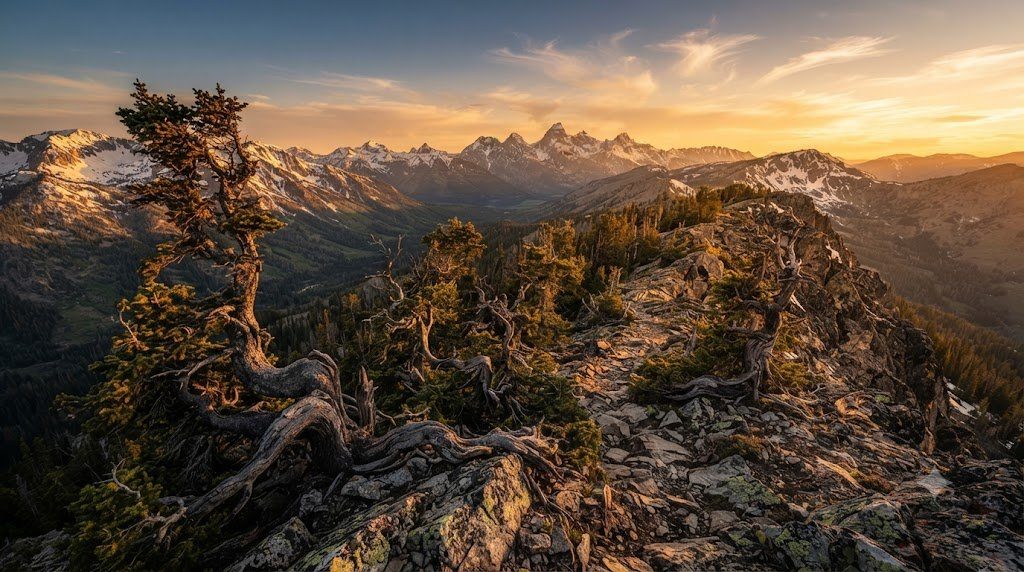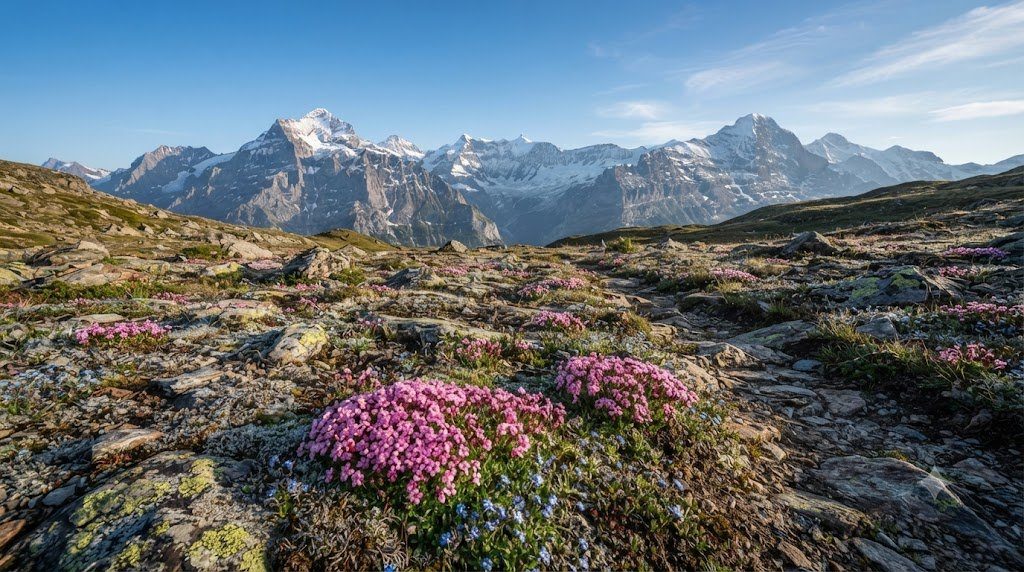
Alpine tundra ecosystems—perched above the climatic timberline across the Rocky Mountains, the European Alps, the Himalayas, and the Scandinavian Scandes—represent the highest terrestrial life zones on Earth. Bounded below by stunted subalpine krummholz ecotones and above by barren permanent nival snow and ice, the alpine tundra operates under severe physical limitations: extreme wind shear exceeding 150 km/h, intense ultraviolet (UV-B) radiation fluxes, severe freezing frost occurring virtually every night of the year, short 45- to 75-day growing seasons, and pervasive periglacial mechanical churning of thin, rocky Cryosol soils. Lacking any upright trees due to severe thermal constraints, alpine tundra is dominated by miniature, ground-hugging botanical architectures: dense cushion plants (such as Silene acaulis), dwarf creeping willows (Salix herbacea), and cold-hardy sedges (Kobresia). Analyzing cryogenic periglacial geomorphology, alpine microclimates, and foliar anthocyanin UV shielding provides fundamental insights into high-altitude biodiversity survival.
The Thermal Ground Boundary Layer: Escaping Alpine Wind Chill
While ambient air temperatures 2 meters above ground in the alpine tundra may hover at a freezing 4°C with hurricane-force winds, the microclimate directly within the lowest 2 to 5 centimeters of the ground surface is astonishingly warm. Dark, rocky soils absorb intense solar radiation, heating a calm, stagnant micro-boundary layer of air to 25°C to 35°C (77°F to 95°F) on sunny days. Alpine plants survive by staying strictly within this thin, warm thermal envelope, completely avoiding the freezing, desiccating winds raging just a few inches above.
1. Periglacial Geomorphology: Solifluction, Cryoturbation, and Patterned Ground
The alpine physical landscape is in constant motion, sculpted by daily and seasonal freeze-thaw cycles through dynamic cryogenic periglacial processes:
- Cryoturbation (Frost Churning): As soil pore water freezes and expands by 9% in volume, differential freezing heaves soil upward. Daily freeze-thaw cycles sort coarse gravels and boulders from fine silts, creating striking geometric landforms: sorted stone polygons, stone nets, and sorted stripes running down mountain slopes.
- Solifluction and Gelifluction Lobes: In late spring, warming temperatures thaw the upper 20 to 50 cm of soil while the subsoil remains frozen and impermeable. Saturated with meltwater, the liquid topsoil slowly flows downhill over the frozen subsoil like wet cement, forming distinctive terraced steps known as solifluction lobes. Alpine plant roots must be exceptionally elastic to withstand this constant downslope shearing.
- Needle Ice (Pipkrake) Mechanical Disturbance: Slender vertical ice needles heaving out of bare mineral soil lift unanchored plant seedlings into the air, severing delicate taproots upon melting and creating barren, frost-disturbed frost boils (mud boils).
2. Cushion Plants: The Aerodynamic Thermal Engineers of the Alpine
The supreme evolutionary life-form of the high alpine zone is the cushion plant—represented by Moss Campion (Silene acaulis), Alpine Sandwort (Minuartia), and Saxifrages (Saxifraga):
Moss campion cushions are astonishingly slow-growing, expanding outward by just 0.5 to 1.5 cm per year. A large cushion measuring 60 cm in diameter can be over 150 to 300 years old, having quietly witnessed centuries of mountain storms.
3. Ultraviolet (UV-B) Radiation Defense and Flavonoid Sunscreens
At high altitudes above 3,500 meters, the thinner atmosphere provides significantly less ozone filtration, exposing plants to intense levels of mutagenic ultraviolet radiation (UV-B, 280–315 nm):
- Flavonoid and Anthocyanin Epidermal Sunscreens: Alpine leaves accumulate exceptionally high concentrations of phenylpropanoid secondary metabolites, specifically flavonols (quercetin, kaempferol) and red anthocyanins. These compounds are deposited directly within the vacuoles of upper epidermal cells, acting as optical filters that absorb over 90% of harmful UV-B wavelengths while transmitting visible photosynthetically active radiation (PAR) to underlying chloroplasts.
- Dense Pubescent Foliar Hairs: Leaves of species like Edelweiss (Leontopodium nivale) are enveloped in thick coats of interwoven white hollow hairs (trichomes). These hairs scatter destructive UV rays while trapping warm, humid air in the leaf boundary layer.
- DNA Photolyase Repair Systems: Alpine plants possess highly active DNA repair enzymes (photolyases) that use blue light to rapidly excise and repair thymine dimers caused by daytime UV-B exposure.
4. Snowbed Ecology: Snow Accumulation and Vegetative Micro-Zonation
Topography and wind construct stark micro-environmental gradients in the alpine tundra via winter snow redistribution:
The Snowbed Gradient: From Fellfields to Late-Lying Snowbanks
Windward mountain ridges are scoured bare of snow by winter gales, forming fellfields where plants (like Dryas octopetala) face brutal -35°C frost and wind desiccation with zero winter insulation. Conversely, lee slopes and depressions trap snowdrifts up to 5 to 10 meters deep. Under these snowbeds, temperatures remain stable at a cozy 0°C all winter, completely protecting plants from freezing winds. However, deep snow melts very late—sometimes not until late July or August—leaving a fleeting 3- to 5-week growing season. Plants inhabiting late-lying snowbeds (such as Dwarf Willow, Salix herbacea) must complete their entire annual vegetative and reproductive cycle within 25 days, storing high concentrations of pre-formed flower buds in autumn.
5. Alpine Fauna: High-Altitude Hypoxia and Thermal Torpor
Vertebrates inhabiting the alpine tundra face the double challenge of severe sub-zero cold and thin, low-oxygen air ($pO_2$ reduced by 40% to 50%):
The American Pika (Ochotona princeps) is a small, cold-adapted lagomorph that cannot tolerate ambient temperatures above 25°C (77°F). Inhabiting rocky talus slopes, pikas do not hibernate; instead, they spend late summer harvesting thousands of pounds of alpine grasses and forbs, curing them in the sun into dry ‘haypiles’ stored deep beneath rock boulders to feed on throughout the long winter beneath the snowpack. Larger mammals like the Bighorn Sheep (Ovis canadensis) and Mountain Goat (Oreamnos americanus) possess specialized split hooves with soft, rubbery traction pads that grip sheer rock ledges, escaping predators like cougars and wolves.
6. Climate Change Threats: Upward Migration and Summit Extinction
Alpine ecosystems are barometers of planetary climate warming, experiencing rapid ecological compression:
As temperatures warm, lower-elevation subalpine trees and aggressive grasses are migrating upward (treeline advance), outcompeting slow-growing alpine cushion plants. Because mountains narrow toward their summits, high-altitude alpine species have progressively less land area to occupy as they migrate higher. Once species reach the highest mountain peaks, they have nowhere higher to go, facing localized extinction—a process known as the ‘Mountaintop Extinction Trap’. Furthermore, shrinking winter snowpacks expose alpine soils to early spring freeze-thaw cycles that kill delicate plant root crowns.
7. Photosynthetic Acclimation: Rubisco Activation and Cold Compensation
Plants in the alpine tundra must conduct efficient photosynthesis at temperatures that would completely shut down lowland crops:
- Low Temperature Thermal Optima: While lowland C3 plants exhibit photosynthetic temperature optima between 20°C and 30°C, alpine plants (like Oxyria digyna and Geum rossii) have shifted their photosynthetic temperature optima down to 10°C to 15°C, retaining up to 50% of maximum photosynthetic capacity at temperatures as low as 2°C to 5°C.
- Elevated Rubisco Enzyme Concentrations: Because low temperatures slow down the catalytic turnover rate of photosynthetic enzymes, alpine leaves invest up to 30% to 40% of their total soluble protein into Rubisco (Ribulose-1,5-bisphosphate carboxylase/oxygenase). This immense enzyme concentration compensates for low thermal kinetic velocity, allowing rapid carbon assimilation during brief sunny windows.
- Non-Photochemical Quenching (NPQ) & Xanthophyll Protection: Under bright alpine midday sun combined with cold temperatures, chloroplasts absorb more light energy than can be utilized in carbon fixation, creating dangerous reactive oxygen species (ROS). Alpine plants dissipate excess energy harmlessly as heat through the xanthophyll cycle (converting violaxanthin to antheraxanthin and zeaxanthin), protecting delicate photosystem II reaction centers from photoinhibition.
8. Soil Pedogenesis: Cryosols and Cold Organic Humus Accumulation
Alpine soils—classified under international systems as Cryosols (Gelisols) and Lithic Leptosols—reflect extreme cryogenic weathering regimes:
Physical frost shattering (gelifraction) fragments solid mountain bedrock into jagged gravel and angular stones. Chemical weathering is severely depressed by near-freezing temperatures, resulting in thin, coarse-textured soils with little clay development. However, cold temperatures also drastically suppress microbial respiration, allowing organic matter from dead cushion roots and sedge leaves to accumulate into dense, dark, acidic turfy humus horizons (umbric epipedons). These organic sponges hold essential moisture during brief midsummer droughts and bind trace nutrients against torrential snowmelt leaching.
9. Alpine Pollination Ecology: The Bumblebee and Fly Mutualisms
Reproduction in the alpine zone is governed by the absence of warm-weather pollinators:
Honeybees and butterflies cannot fly in freezing alpine winds. Instead, pollination is performed almost exclusively by cold-tolerant Bumblebees (Bombus species) and diverse families of flies (Diptera: Syrphidae and Muscidae). Bumblebees generate internal heat through endothermic thoracic shivering, allowing them to fly and buzz-pollinate alpine louseworts (Pedicularis) and gentians at ambient temperatures near 0°C. Many alpine flowers (such as Dryas and Ranunculus) exhibit heliotropism: their parabolic, cup-shaped flowers track the sun across the sky like satellite dishes, reflecting solar heat onto central reproductive pistils, warming them by up to 5°C to 8°C above ambient air to accelerate ovule fertilization and attract sun-seeking pollinating flies.
Furthermore, many high-altitude plants rely on vegetative apomixis and bulbils (such as Polygonum viviparum) when severe weather prevents insect flights altogether. Producing clonal miniature plantlets directly on floral spikes allows plants to reproduce successfully even during years when summer blizzards destroy flowers, providing reproductive insurance against mountain climatic unpredictability.
These mutualistic networks are fragile: early spring snowmelt uncouples historical phenological timing, causing flowers to bloom before bumblebee queens emerge from winter hibernation, creating critical ecological mismatches under rapid climate change.
10. Frequently Asked Questions Regarding Alpine Tundra
Q: What defines the alpine timberline?
The alpine timberline is the high-elevation boundary above which trees cannot grow due to low temperatures; it generally corresponds to the isotherm where the warmest summer month averages less than 10°C (50°F).
Q: Why do alpine plants grow in compact low cushions?
Cushion plants hug the ground to stay inside the warm, calm microclimatic boundary layer near the soil surface, deflecting high winds and avoiding freezing wind chill.
Q: How old can a Moss Campion (Silene acaulis) cushion be?
Because they expand by only a few millimeters per year, large cushions measuring 50 to 60 cm in diameter are frequently 150 to over 300 years old.
Q: How do alpine plants protect their DNA from intense UV radiation?
They accumulate high concentrations of flavonoid and anthocyanin pigments in their leaf epidermis that act as natural sunscreens, absorbing over 90% of harmful UV-B rays.
Q: How do American pikas survive freezing winter without hibernating?
Pikas spend summer collecting grasses and wildflowers, curing them in the sun into dry haypiles stored beneath talus boulders, eating stored hay all winter beneath the snow.
Q: What is solifluction in alpine periglacial landscapes?
Solifluction is the slow downslope flow of water-saturated topsoil over an impermeable frozen subsoil layer during spring thaw, forming distinctive stepped terraces.
Q: Why are alpine fellfields so harsh for plant life?
Fellfield ridges are scoured bare of snow by gale-force winter winds, exposing plants to bone-chilling sub-zero frost and drying winds without the protective thermal blanket of snow.
Q: What is the ‘mountaintop extinction trap’ under climate warming?
As climate warms, alpine species migrate up mountains to find cool temperatures. When they reach the physical summits, they have nowhere higher to migrate and face extinction.
Q: What is heliotropism in alpine flowers like Dryas and buttercups?
Heliotropism is when flowers track the sun like satellite dishes, reflecting solar heat onto their central reproductive organs to warm them by up to 8°C and attract pollinating flies.
Q: Why do bumblebees thrive as pollinators in cold alpine environments?
Bumblebees can decouple their wings and shiver their thoracic muscles to generate internal metabolic heat, allowing them to fly and forage at temperatures close to freezing.