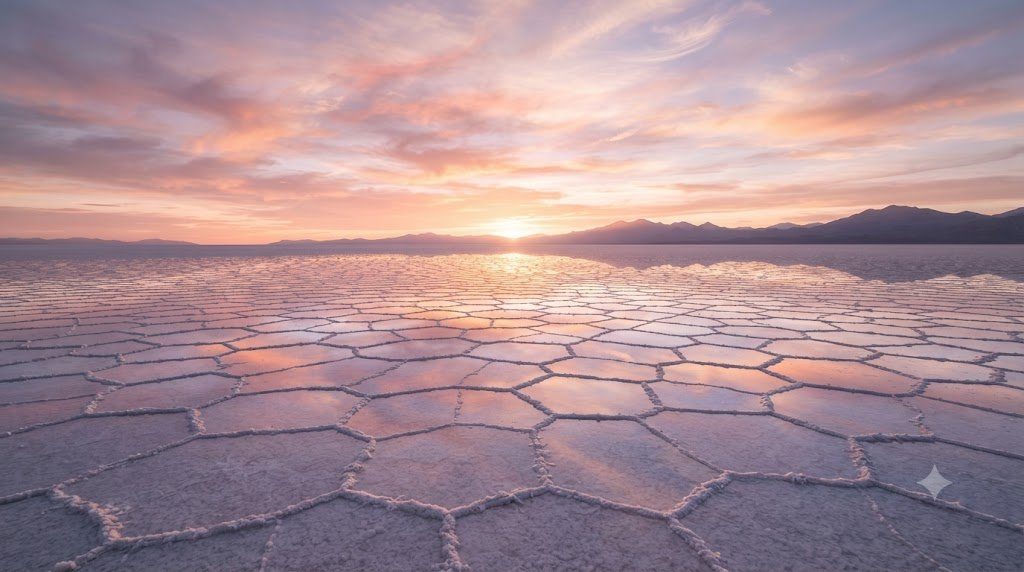
Desert playas, terminal salt pans, and saline dry lake beds—spectacularly represented by the Salar de Uyuni in Bolivia, Death Valley’s Badwater Basin in North America, the Etosha Pan in Namibia, and Lake Eyre in Australia—represent the ultimate geomorphic and geochemical endpoints of endorheic drainage basins across global arid biomes. Lacking any outlet to the sea, these closed topographical depressions accumulate runoff, dissolved mineral salts, and fine clays from surrounding mountain ranges over millions of years. Characterized by blinding white evaporite crusts, extreme hyper-salinity, intense ground surface temperatures, and violent shifts between dry desiccation and ephemeral shallow flooding, playas are severe geochemical cauldrons. Yet despite extreme physical stress, playas support specialized halophytic plant zonation, unique extremophilic microbial ecologies, and explosive boom-and-bust breeding events of nomadic waterbirds like Flamingos. Analyzing the mineral crystallization sequences, halophytic osmoregulation, and lithium brine biogeochemistry of terminal playas is vital for arid conservation.
The Endorheic Basin Evaporation Engine
In an endorheic (internally draining) desert basin, water enters via seasonal flash floods, ephemeral mountain streams, and subterranean groundwater seeps, but there is zero surface river outlet to the ocean. Because annual potential evapotranspiration (typically 2,000 to 3,500 mm) exceeds precipitation by twenty to fifty times, standing floodwaters evaporate rapidly. As water evaporates into the atmosphere, non-volatile dissolved mineral salts are left behind, precipitating into blinding white crusts of pure halite, gypsum, and borates.
1. Geomorphic Evolution and Evaporite Mineral Crystallization Sequences
The formation of mineral crusts across desert playas follows a strict thermodynamic solubility sequence known as the Usiglio Evaporation Precipitation Cascade:
- 1. Carbonate Mineral Stage (Early Precipitation): When an ephemeral lake evaporates to roughly 50% of its original volume, low-solubility minerals precipitate first around the playa fringes: Calcium Carbonate ($CaCO_3$ as calcite and aragonite) and Dolomite.
- 2. Sulfate Mineral Stage (Intermediate Concentration): When lake volume shrinks to 20%, calcium sulfate precipitates, forming thick, glittering beds of Gypsum ($CaSO_4 \cdot 2H_2O$) and Anhydrite.
- 3. Chloride Mineral Stage (Late Stage Evaporite Core): When volume shrinks to 10% of the original water body, common salt—Halite ($NaCl$)—precipitates out, forming the rock-hard, blinding white salt flats that cover the playa center.
- 4. Bitter Salts & Rare Evaporite Brines (Final Stage): The final residual ‘bitter’ mother brines precipitate highly soluble magnesium and potassium salts (Sylvite $KCl$, Carnallite), sodium sulfates (Thenardite), and economically valuable Lithium and Borate minerals (Borax, Ulexite).
2. Comparative Playa Morphometrics and Geochemical Profiles
Comparing the world’s premier terminal salt pans illustrates the vast geographical scale and varying chemical profiles of closed arid basins:
3. Halophytic Plant Zonation: Surviving Toxic Osmotic Potentials
Plants cannot grow on the pure halite salt crust at the center of a playa due to lethal salinity ($> 300$ ppt). However, as one moves outward from the playa center toward the margins, salinity declines, producing distinct concentric rings of halophytic plant zonation:
- Pioneer Pickleweed Zone (Salicornia / Sarcocornia): Growing immediately along the hyper-saline mud fringe. Pickleweeds are extreme succulent halophytes that survive soil salinity exceeding 3% to 6% by accumulating sodium and chloride ions inside large cellular vacuoles to maintain osmotic balance, producing fleshy, segmented, leafless green stems that turn bright crimson in autumn.
- Saltbush Zone (Atriplex species): Dominating mid-salinity terraces. Saltbush species utilize specialized epidermal salt bladders (trichomes). Active ion pumps pump toxic sodium out of living leaf cells into these surface hairs. As salt accumulates, the hair swells and bursts, depositing crystalline salt on the leaf exterior and shedding it from the plant.
- Black Greasewood Zone (Sarcobatus vermiculatus): Occupying the outer playa margin where groundwater tables are relatively shallow. Greasewood is a deep-rooted phreatophyte capable of extracting water from sodium-saturated soils, accumulating high levels of sodium oxalate that make foliage unpalatable to herbivores.
4. Microbial Extremophiles: Haloarchaea and Dunaliella salina
When ephemeral flash floods dissolve salt crusts, terminal playas transform into hyper-saline brines inhabited by specialized microbial extremophiles that turn the water vivid pink and red:
The Pink Salt Waters of Haloarchaea and Dunaliella
In saturated brine pools where salt concentrations approach 30% saturation, ordinary organisms undergo instantaneous cellular collapse and death. These pools are dominated by two extremophiles: the halophilic green alga Dunaliella salina and extreme halophilic Archaea (Haloarchaea / Halobacterium). To prevent water from rushing out of their cells via osmosis, Dunaliella synthesizes massive quantities of intracellular glycerol and bright red beta-carotene pigments. Haloarchaea synthesize bacteriorhodopsin—a purple-red light-harvesting protein in their cell membranes that converts sunlight directly into ATP energy. These red carotenoid pigments protect cells from UV radiation and give terminal salt lakes their striking pink, orange, and blood-red coloration.
5. Ephemeral Invertebrates and Boom-and-Bust Bird Migrations
Terminal playas represent dramatic ‘boom-and-bust’ biological systems driven by unpredictable rainfall cycles:
For years or decades, a playa can lie completely dry, cracked, and apparently lifeless. Beneath the salt crust lie billions of dormant cyst eggs of Brine Shrimp (Artemia) and ephemeral Fairy Shrimp and Tadpole Shrimp (Triops). When an extraordinary regional flood fills the playa into a shallow lake, these desiccation-resistant eggs hatch within 24 to 48 hours. Feeding on abundant Dunaliella algae, the shrimp reproduce prolifically, reaching densities of tens of thousands of individuals per cubic meter of water within three weeks.
Sensing these flood events across hundreds of miles, nomadic waterbirds—most spectacularly Flamingos (Phoenicopterus) and Australian Pelicans—arrive in flocks numbering hundreds of thousands. Flamingos construct conical mud nests on the shallow salt flats, safe from terrestrial predators who cannot walk across the treacherous mud, feeding on carotenoid-rich brine shrimp that paint their feathers vivid pink.
6. The Global Lithium Triangle: The Threat of Brine Pumping
Today, the terminal playas of South America’s ‘Lithium Triangle’ (Bolivia’s Salar de Uyuni, Chile’s Salar de Atacama, and Argentina’s Salar del Hombre Muerto) face immense pressure from the global green energy transition:
Over 50% of the world’s known lithium reserves are dissolved in subterranean brines beneath these Andean salt pans. Industrial mining companies pump millions of liters of mineral-rich brine per day from deep aquifers into massive evaporation ponds to extract battery-grade lithium carbonate. This massive water extraction drops regional groundwater tables, drying out adjacent freshwater wetland springs and bofedales, severely threatening indigenous pastoral communities and flamingo nesting colonies.
7. Endemic Pupfish Evolution in Saline Springs and Marsh Outflows
Bordering terminal salt flats in desert grabens are tiny, isolated thermal freshwater-to-saline springs inhabited by evolutionary marvels: Desert Pupfish (Cyprinodon species), such as the Devils Hole Pupfish (Cyprinodon diabolis) and Salt Creek Pupfish (Cyprinodon salinus) in Death Valley:
- Surviving Extreme Thermal & Salinity Swings: Pupfish tolerate the widest physiological water chemistry fluctuations of any known vertebrates. Salt Creek pupfish survive in shallow streams where water temperatures swing from freezing 0°C in winter up to an astonishing 43°C (110°F) in summer, with water salinity reaching three times that of normal ocean water (over 100 ppt).
- Extreme Speciation in Aquifer Refugia: When ancient Pleistocene lakes dried up 10,000 years ago, ancestral pupfish populations became trapped in isolated subterranean limestone cavern pools and springheads. Isolated from gene flow, each spring evolved into a distinct, genetically isolated endemic species with populations often numbering fewer than 100 to 500 individuals.
- Acute Vulnerability to Groundwater Over-Pumping: Because pupfish depend on shallow limestone feeding shelves submerged beneath just 30 to 60 cm of water, regional agricultural and municipal groundwater pumping that lowers the water table by even a few inches permanently dries out their spawning substrate, pushing species to the brink of extinction.
8. Salt Crust Geomorphology: Tepee Structures and Hexagonal Salt Polygons
The blinding white surface of terminal halite salt flats is not smooth; it is fractured into monumental geometric patterns visible from space:
As saturated brine evaporates through subterranean capillary action, new halite salt crystals precipitate continuously within the pore spaces of the surface crust. As crystal volume expands, the lateral pressure forces the salt crust to buckle upward along regular stress vectors, forming massive, interlocking hexagonal salt polygons measuring 1 to 3 meters across. Along the polygon margins, expanding salt forces the edges upward into jagged vertical ridges called tepee structures (salt ridges). In ultra-arid depressions like Death Valley’s Devil’s Golf Course, decades of crystal growth and wind-driven salt spray carve jagged, razor-sharp pinnacles of halite up to 60 cm tall.
9. Dust Emissions, Toxic Alkali Dust, and Respiratory Hazards
When desert lakes are artificially desiccated by human water diversions—most notoriously California’s Owens Lake, the Great Salt Lake in Utah, and Central Asia’s Aral Sea—playa beds become planetary sources of toxic alkali dust:
Desiccated lake beds consist of fine, unbonded silt, sodium carbonate salts, and toxic trace elements including arsenic, cadmium, lead, and nickel. Powerful desert winds easily loft these fine respirable particulates ($PM_{2.5}$ and $PM_{10}$) into massive, blinding white dust plumes (haboobs) that travel hundreds of kilometers downwind. These plumes generate the highest concentrations of airborne particulate pollution in North America, triggering chronic asthma, pulmonary inflammation, and long-term health crises in surrounding human communities while depositing corrosive salts onto adjacent agricultural fields.
Modern dust mitigation engineering requires massive investments—such as Owens Lake’s $2.5 billion dust control program—deploying shallow flooding, gravel blankets, and native saltgrass (Distichlis spicata) managed plantings to stabilize loose playa sediments and curb atmospheric emissions.
10. Frequently Asked Questions Regarding Desert Playas
Q: What is an endorheic basin?
An endorheic basin is a closed drainage basin where water enters via streams and rainfall but has no surface outflow to the ocean, losing water exclusively through evaporation.
Q: Why are salt flats blindingly white in color?
As standing lake waters evaporate, dissolved sodium chloride (halite) and gypsum crystallize into pure, reflective white mineral crusts across the dry lake bed.
Q: What causes the bright pink color in hyper-saline desert salt lakes?
The pink color is caused by millions of extremophile microbes: Dunaliella salina algae producing beta-carotene and Haloarchaea containing purple-red bacteriorhodopsin pigments.
Q: How do brine shrimp eggs survive years of complete desert desiccation?
Brine shrimp produce cyst eggs with hard protective shells that enter cryptobiosis (metabolic arrest), surviving freezing cold, baking sun, and drought for years until water returns.
Q: Why do flamingos nest on isolated desert salt pans?
Flamingos nest on salt flats because shallow water and treacherous salt mud protect their nesting colonies from terrestrial mammalian predators like coyotes, foxes, and wild cats.
Q: What is Salicornia (pickleweed) and how does it survive on salt pan edges?
Salicornia is a succulent halophytic plant that accumulates salt inside its vacuoles to absorb water from saline soils, turning bright green in spring and crimson red in autumn.
Q: Why are Andean salt flats so important for electric vehicle batteries?
Subterranean brines beneath Andean salt flats contain the world’s highest concentrations of dissolved lithium, essential for manufacturing lithium-ion batteries.
Q: What is a mud polygon on a dry playa floor?
As wet playa mud dries and shrinks, mechanical tension causes the clay surface to crack into geometric hexagonal polygons that interlock across miles of flat terrain.
Q: How do Desert Pupfish survive in hot, hyper-saline desert springs?
Desert pupfish have extraordinary physiological osmoregulation, surviving water temperatures from freezing up to 43°C (110°F) and salinity levels three times saltier than the ocean.
Q: What are tepee structures on salt flats?
Tepee structures are jagged, tent-shaped ridges formed along the edges of giant salt polygons when expanding halite crystals push the crust upward under lateral pressure.
Q: Why is drying out saline lakes like the Great Salt Lake dangerous for human health?
Drying lakebeds expose dry silt contaminated with toxic arsenic and heavy metals. High winds lift this into toxic dust clouds that cause respiratory diseases in nearby cities.
Q: What is the difference between a wet playa and a dry playa?
A wet playa has a shallow groundwater table within 1-2 meters of the surface that continually evaporates and deposits moist salt, while a dry playa has a deep water table and forms a hard, dry clay crust.