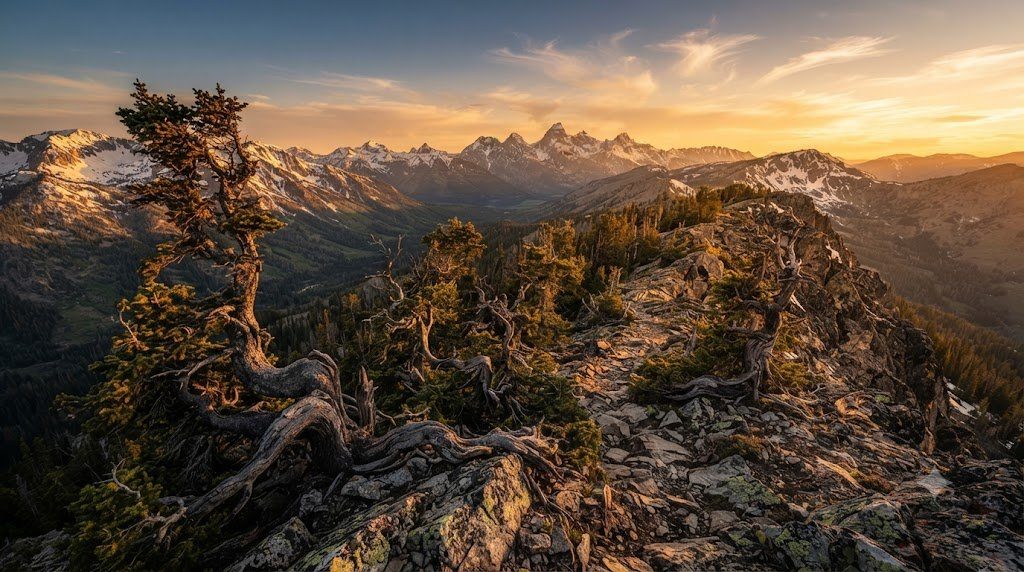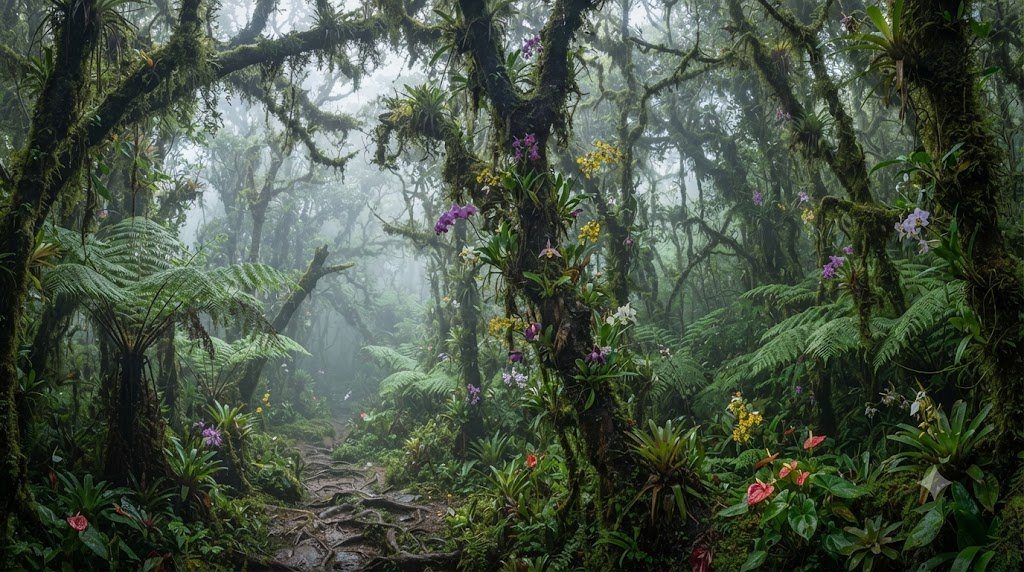
Tropical Montane Cloud Forests (TMCFs) represent some of the most biodiverse, hydrologically vital, and fragile ecosystems on Earth. Perched along rugged tropical mountain ranges where prevailing trade winds force moist air masses to ascend, condense, and form persistent cloud immersion, these “fog forests” operate under unique atmospheric and biological dynamics. Through horizontal precipitation interception, hyper-abundant epiphytic bryophyte mats, and intense geographical isolation across steep altitudinal gradients, cloud forests function as evolutionary cradles of extraordinary endemism and irreplaceable regional freshwater reservoirs.
Key Ecological Definition: Tropical Montane Cloud Forest (TMCF)
A tropical montane cloud forest is defined by the persistent, frequent presence of fog and low-level cloud immersion at the vegetation canopy level. This atmospheric phenomenon creates microclimates characterized by reduced solar irradiance, suppressed vapor pressure deficits, high relative humidity, and significant occult precipitation that bypasses standard vertical rainfall measurements.
1. Atmospheric Mechanisms: Orographic Lifting and Condensation Belts
The fundamental driver of tropical cloud forest formation is orographic lifting. When maritime tropical air masses driven by easterly trade winds or monsoonal circulations encounter high continental cordilleras or oceanic volcanic island ridges, the air mass is physically forced upward along the windward mountain slopes. As the air ascends, it expands adiabatically under declining atmospheric pressure, cooling at the dry adiabatic lapse rate (approximately 9.8°C per 1,000 meters) until it reaches its dew point temperature.
Upon reaching saturation, water vapor condenses into microscopic liquid droplets, establishing the lifting condensation level (LCL). This altitude marks the base of the perpetual cloud belt, typically spanning elevations between 1,000 and 3,000 meters above sea level depending on latitude, mountain mass elevation effects (the Massenerhebung phenomenon), and coastal proximity. Within this saturated stratum, ambient relative humidity rarely drops below 95%, and the forest canopy remains continuously bathed in drifting cloud mist for hundreds of hours each month.
2. Hydrological Dynamics: Occult Precipitation and the Sponge Effect
The hallmark hydrological process distinguishing cloud forests from all other tropical forest formations is horizontal precipitation interception, commonly known as cloud stripping, occult precipitation, or fog drip. While standard rain gauges capture only vertical rainfall, cloud forests extract significant volumes of liquid water directly from passing fog banks:
- Aero-Dynamic Droplet Interception: The complex architectural structure of cloud forest trees—characterized by dense, tortuous branches, narrow foliage, and vast surface areas of epiphytic mosses—functions as an efficient physical filter. Microscopic fog droplets (diameters between 10 and 30 microns) impact fine plant leaves and moss leaflets, coalescing into larger droplets under surface tension.
- Augmentation Beyond Vertical Rainfall: Intercepted horizontal fog drip flows down stems (stemflow) or drips from branches (throughfall), adding an extra 15% to 75% of net hydrological input on top of recorded vertical rainfall. In exceptionally dry seasons, fog interception can provide over 100% of total moisture inputs, preventing drought stress when clear-sky precipitation ceases entirely.
- Suppressed Evapotranspiration: Because the cloud veil blocks direct sunlight (reducing incoming photosynthetically active radiation by 30% to 60%) and maintains near-zero atmospheric vapor pressure deficits (VPD), canopy transpiration is severely dampened. Trees lose minimal water, allowing virtually all intercepted moisture to percolate downward into soils and headwater streams.
- The Sponge Effect and Downstream Regulation: Deep, organic-rich histic soils combined with thick bryophyte cushions act as a vast natural sponge. Cloud forests absorb intense precipitation pulses, filtering runoff and releasing baseflows steadily throughout prolonged dry periods. Downstream human communities, agricultural plains, and hydroelectric reservoirs depend completely on this steady, regulated flow.
3. Structural Adaptations and Canopy Epiphytism
Forests growing within perpetual cloud belts exhibit distinct physiognomic characteristics that starkly contrast with lowland tropical rainforests. Lowland forests boast towering straight trunks reaching 50 to 60 meters, expansive buttress root systems, and massive woody lianas. In sharp contrast, cloud forest trees are characterized by:
Stunted Architecture and Gnarled Stems: Stems are twisted, heavily branched, and low-statured, rarely exceeding 15 to 25 meters in height (and shrinking to under 5 meters in high-elevation dwarf elfin forests). Trunks are coated in thick, sponge-like coats of liverworts and mosses that obscure the underlying bark.
Pachyphyllous Leaves and Drip Tips: Tree foliage exhibits pachyphylly—leaves are small, thick, leathery, and heavily cutinized to resist mechanical abrasion from high winds and prevent cellular flooding. While lowland leaves possess elongated “drip tips” to shed standing rainwater, cloud forest leaves often possess micro-serrations and dense wax layers that shed moisture quickly to prevent epiphyllous algae and lichen crusts from suffocating photosynthetic stomata.
4. Epiphyte Communities: Aerial Gardens and Suspended Soils
Tropical montane cloud forests support the highest concentration and biomass of epiphytes found anywhere in the plant kingdom. Epiphytes are plants that grow non-parasitically upon host trees, using branches and trunks solely for mechanical support. In mature cloud forests, epiphytic biomass can equal or exceed the foliar biomass of the host trees themselves:
- Bryophyte Blankets: Non-vascular bryophytes—predominantly leafy liverworts (Jungermanniopsida) and pleurocarpous mosses—cover every square centimeter of bark, creating thick moisture blankets up to 20 centimeters deep. These moss mats possess astonishing water-holding capacities, absorbing up to 300% to 800% of their dry weight in water.
- Orchids (Orchidaceae): Cloud forests are global epicenters of orchid diversification, hosting thousands of miniature and showy species (e.g., Pleurothallis, Lepanthes, Masdevallia, and Dracula). They utilize specialized velamen radicum—a multi-layered, sponge-like dead epidermis covering their aerial roots—that instantly absorbs atmospheric mist and dissolved canopy nutrients.
- Bromeliads (Bromeliaceae): Tank bromeliads form rosette cups that impound liters of rainwater and organic debris, creating specialized aerial aquatic habitats (phytotelmata) that support endemic tree frogs, salamanders, and aquatic insect larvae dozens of meters above the forest floor.
- Canopy Soil Formation: Over centuries, decaying epiphyte tissues, trapped wind-blown dust, and animal droppings accumulate beneath moss mats, forming rich organic horizons known as canopy soils (suspended soils). Host trees actually extend adventitious canopy roots directly from their upper branches into these aerial soil beds to reabsorb nutrients recycled high above the ground!
5. Biogeographical Sky Islands and Evolutionary Endemism
Because tropical mountains feature sharp altitudinal temperature and moisture gradients, cloud forests exist as fragmented, isolated habitat archipelagos perched atop mountain crests—often termed continental sky islands. Each isolated mountain range or peak acts as an evolutionary laboratory, driving rapid allopatric speciation:
High-altitude taxa cannot cross intervening hot, dry lowland valleys. Over evolutionary timescales, populations trapped on separate peaks diverge into distinct species with remarkably narrow geographic ranges, sometimes restricted to a single ridge or watershed. As a result, cloud forests boast some of the highest concentrations of single-site endemic vertebrates and plants on Earth:
- The Resplendent Quetzal (Pharomachrus mocinno): Revered in Mesoamerican mythology, this spectacular trogon relies exclusively on mature, epiphyte-laden cloud forests from southern Mexico to Panama, feeding primarily on wild montane avocados (Lauraceae).
- Spectacled Bear (Tremarctos ornatus): South America’s only native bear species roams the Andean cloud forests (the Ceja de Selva or “eyebrow of the jungle”), navigating steep cloud-cloaked cliffs to feed on terrestrial bromeliad hearts, bamboo shoots, and palm fruits.
- Mountain Gorillas (Gorilla beringei beringei): In the volcanic cloud forests of the Virunga Range and Bwindi Impenetrable Forest in East Africa, mountain gorillas depend on dense herbaceous understories nourished by continuous montane mist.
- Amphibian Micro-Endemics: Cloud forests are the world’s most critical sanctuaries for salamanders (such as lungless plethodontid salamanders) and poison dart frogs, which depend completely on perpetually damp moss mats and tank bromeliads to keep their cutaneous respiratory surfaces moist.
6. Major Geographic Realms of Cloud Forest Distribution
Although tropical montane cloud forests represent less than 2.5% of the world’s remaining tropical forests, they are distributed across three primary biogeographic realms:
1. The Neotropics (Americas): The Andes Cordillera (stretching across Colombia, Ecuador, Peru, and Bolivia) contains the largest contiguous expanse of cloud forests on Earth, locally termed the Yungas and Bosque de Niebla. Central America hosts world-renowned cloud reserves in Costa Rica (Monteverde), Guatemala, and the Sierra Madre of Mexico.
2. The Afrotropics (Africa): Isolated ancient volcanic and rift-valley mountains harbor critical cloud forests, including the Eastern Arc Mountains of Tanzania and Kenya (renowned for ancient endemic African violets), Mount Cameroon, the Ruwenzori Mountains, and the Ethiopian Highlands.
3. The Indo-Malayan & Australasian Realms: Towering cordilleras across New Guinea, Borneo (Mount Kinabalu, harboring the world’s richest assemblage of pitcher plants), Sumatra, the Western Ghats of India (Shola forest mosaics), and high-elevation volcanic slopes of Hawaii host unique assemblages characterized by ancient southern conifers (Podocarpaceae) and tree ferns (Cyatheaceae).
7. Threats: The Lifting Cloud Base Hypothesis and Climate Warming
Of all terrestrial biomes, cloud forests are arguably the most immediately vulnerable to anthropogenic global climate change due to the Lifting Cloud Base Hypothesis (pioneered by ecologist Robert Lawton and colleagues):
As sea surface temperatures rise and lowland air masses warm, warmer air requires significantly more water vapor to achieve saturation. Consequently, the lifting condensation level (LCL) is shifting upward in elevation. Clouds that historically formed at 1,200 meters are now forming at 1,500 or 1,800 meters. For cloud forests occupying narrow mountain summits, this shifts the cloud deck entirely above the peaks into empty sky—effectively drying out the ecosystem and robbing it of its vital occult precipitation.
This phenomenon triggered the tragic extinction of the Golden Toad (Incilius periglenes) in the cloud forests of Monteverde, Costa Rica—the world’s first documented modern vertebrate extinction directly attributed to climate-induced ecological drying and the proliferation of the chytrid fungus (Batrachochytrium dendrobatidis) in desiccating breeding pools.
8. Agricultural Encroachment, Cattle Ranching, and Forest Fragmentation
Beyond climate shifts, direct land-use change poses an immediate existential threat to cloud forests. Steep mountain slopes are relentlessly cleared for:
- Highland Agriculture and Specialty Cash Crops: The cool, frost-free climates and rich volcanic soils of cloud forest zones make them prime targets for high-altitude cash crop cultivation, particularly shade and sun coffee (Coffea arabica), tea plantations, cardamom, and avocados.
- Extensive Cattle Ranching: Slopes are deforested and burned to establish non-native kikuyu grass pastures for dairy and beef cattle. Once cleared, topsoils quickly compact under heavy cattle hooves, losing their water-holding capacity and triggering catastrophic landslides during heavy rainstorms.
- Firewood and Charcoal Extraction: Rural mountain communities depend on slow-growing montane hardwoods (such as native oaks, Quercus spp.) for domestic cooking fuel and commercial charcoal production, gradually thinning and fragmenting ancient forest canopies.
9. Conservation Frontiers: Payment for Ecosystem Services and Biological Corridors
Conserving cloud forests requires innovative economic and landscape-level frameworks that value the ecosystem services these forests deliver to downstream beneficiaries:
Payment for Ecosystem Services (PES): Pioneered at a national scale by Costa Rica, PES programs levy water tariffs on municipal water users, agricultural irrigators, and hydroelectric utilities. These revenues are paid directly to private landowners and indigenous communities who maintain standing cloud forests on their properties, directly compensating them for protecting regional watershed headwaters.
Altitudinal Biological Corridors: Because species must migrate upward to track shifting thermal envelopes as the planet warms, isolated summit reserves are insufficient. Conservationists are establishing continuous protected corridors stretching from lowland rainforests up through submontane, cloud forest, and alpine paramos. These intact elevation gradients allow flora and fauna to adjust their spatial ranges without encountering impassable agricultural barriers.
10. Frequently Asked Questions Regarding Tropical Montane Cloud Forests
Q: What defines a Tropical Montane Cloud Forest?
A cloud forest is a tropical mountain forest characterized by persistent, frequent canopy-level cloud and fog immersion, creating high relative humidity, low sunlight, and abundant epiphytes.
Q: What is horizontal precipitation or cloud stripping?
Horizontal precipitation is liquid water extracted directly from passing fog banks by leaves and mosses, adding 15% to 75% more water to the forest than standard rainfall.
Q: Why are cloud forest trees shorter and more gnarled than lowland trees?
Trees are stunted due to cooler temperatures, persistent wind exposure, waterlogged acidic soils, limited solar radiation, and reduced nutrient uptake rates.
Q: What are canopy soils or suspended soils?
They are rich organic soil layers formed high up in tree branches by decades of decaying epiphytic mosses, leaf litter, and airborne dust, which trees tap into with aerial roots.
Q: Why do cloud forests have such high levels of endemism?
Because they exist on isolated mountain peaks (‘sky islands’) separated by warm lowlands, populations evolve independently in isolation, generating species found nowhere else.
Q: What is the Lifting Cloud Base Hypothesis?
Warming global temperatures mean air must rise higher before cooling to its condensation point, causing the cloud layer to lift above mountain summits and desiccating cloud forests.
Q: How do cloud forests protect downstream communities?
They act like massive sponges, absorbing torrential storm rainfall, preventing destructive flash floods and mudslides, and releasing water slowly to sustain rivers in dry seasons.
Q: What is the connection between cloud forests and the Golden Toad?
The Golden Toad of Costa Rica went extinct after climate-induced cloud lifting dried out mountain breeding pools, combined with the spread of a lethal chytrid fungus.
Q: Why are epiphytic bryophytes so vital to cloud forest hydrology?
Epiphytic mosses and liverworts can absorb between 300% and 800% of their dry weight in water, catching and holding immense amounts of fog drip that slowly enters the soil.
Q: What are the most famous animals living in cloud forests?
Iconic cloud forest wildlife includes the Resplendent Quetzal, Spectacled Bear, Mountain Gorilla, Andean Cock-of-the-rock, and hundreds of unique frog and salamander species.