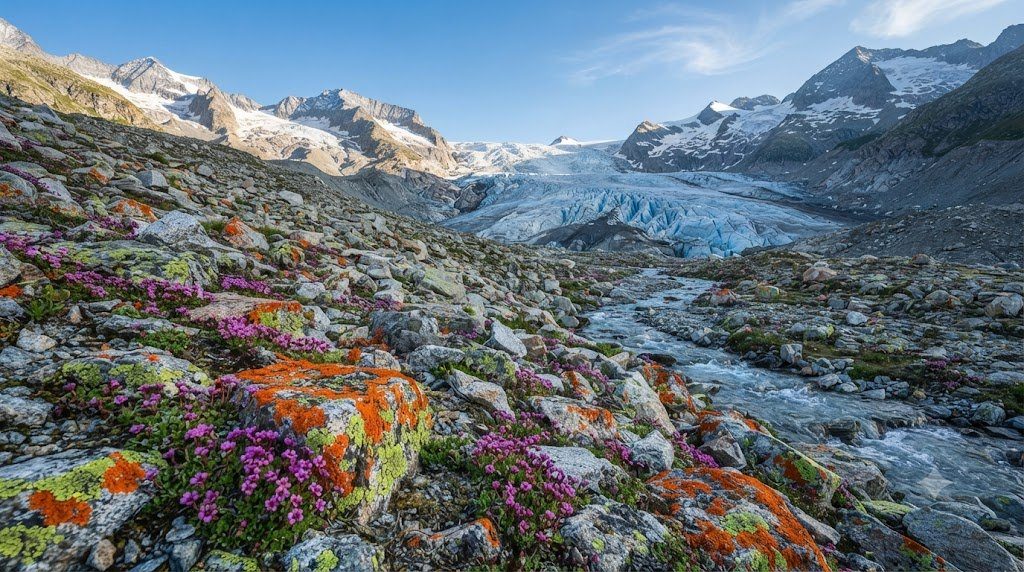
Glacier Forelands and Talus Scree Slopes represent the absolute terrestrial frontier of primary ecological succession and geomorphic disturbance. As alpine glaciers undergo unprecedented global retreat due to accelerated climatic warming, they expose raw, sterile expanses of bedrock, pulverized glacial flour, and unstable morainic debris. Across these barren proglacial landscapes and the gravity-driven rockfall slopes that flank them, pioneering organisms—from crustose lichens and nitrogen-fixing biocrusts to specialized scree-runner plants—execute miraculous colonization sequences, transforming lifeless mineral rubble into stable alpine ecosystems.
Key Ecological Concept: Glacier Foreland Chronosequence
A glacier foreland chronosequence is a ‘space-for-time’ substitution gradient spanning from the actively retreating ice margin to historically exposed terrain down-valley. The distance from the glacial snout corresponds directly to the age of terrain exposure (from 0 to over 150+ years since the Little Ice Age maximum), allowing ecologists to study centuries of primary ecological succession in a single field walk.
1. Geomorphic Architecture: Moraines, Talus Sheets, and Scree Cones
To understand primary colonization in high mountains, one must first analyze the physical geomorphology of periglacial and proglacial landscapes:
Glacial Moraines: Glaciers act as colossal conveyor belts of rock debris. As ice advances and retreats, it deposits unsorted, unstratified sediment known as glacial till. Terminal and recessional moraines form steep, ridged embankments of boulders, gravel, and pulverized rock flour. Lateral moraines border the valley walls, frequently subject to slumping, permafrost thaw degradation, and meltwater erosion.
Talus Scree Slopes: Above the valley floors, towering headwalls and precipitous cliff faces undergo relentless physical weathering driven by diurnal freeze-thaw cycles (frost wedging). Water seeps into rock fractures, expands by 9% upon freezing, and wedges giant boulders and angular gravel loose. This fallen rock debris accumulates at the base of cliffs, forming steep slope deposits known as talus sheets or individual triangular scree cones.
The Critical Angle of Repose: Scree slopes are structurally defined by the angle of repose—the maximum shear angle at which loose granular material remains stable without sliding downward under gravity. For jagged, angular periglacial rock debris, this critical threshold typically rests between 32° and 38°. The slightest disturbance—a stepping ungulate, falling pebble, or rainstorm—triggers gravitational rockslides, making talus slopes one of the most mechanically unstable environments on Earth.
2. The Sterile Starting Point: Physical and Chemical Barriers to Colonization
When a glacier retreats, the newly exposed proglacial foreland (Terrain Age = 0 years) presents extreme abiotic challenges that prevent immediate vascular plant survival:
- Complete Nutrient Absence: Glacial till is composed entirely of unweathered parent mineral rock. It contains zero organic matter, virtually undetectable levels of available plant nitrogen ($NH_4^+$ and $NO_3^-$), and extremely limited bioavailable orthophosphate ($PO_4^{3-}$).
- Microbial Inhospitality: Raw till lacks established mycorrhizal fungal networks and beneficial rhizobacteria essential for vascular plant root nutrient absorption.
- Extreme Thermal Fluctuations: Without organic insulation or vegetation cover, dark rock surfaces reach scorching temperatures above 45°C under intense high-altitude summer sun, then plummet below -15°C within hours as night falls.
- Severe Geomorphic Instability: Active meltwater streams braid across forelands, burying nascent patches under thick layers of glacial silt, while permafrost thaw causes sudden ground collapse (thermokarst subsidence).
3. Chronosequence Successional Stages: From Pioneer Microbes to Dwarf Shrub Tundra
Ecologists trace primary succession across glacier forelands through distinct chronosequence zones representing decades of soil and community development:
4. The Biological Soil Crust and Lichen Pioneer Guild
The unsung heroes that initiate pedogenesis (soil genesis) on bare glacial till are microscopic biological soil crusts (biocrusts) and lithophytic lichens:
Within months of ice retreat, airborne spores of cyanobacteria (such as Nostoc commune) colonize the moist, pulverized rock flour. Cyanobacteria secrete sticky extracellular polymeric substances (EPS)—long-chain polysaccharides that bind loose mineral grains together, forming a coherent surface crust that resists wind and water erosion. Crucially, cyanobacteria contain specialized cells called heterocysts that perform biological nitrogen fixation, converting inert atmospheric nitrogen ($N_2$) into bioavailable ammonium, thereby laying down the foundational nitrogen pool of the entire nascent ecosystem.
Simultaneously, crustose lichens—notably the Map Lichen (Rhizocarpon geographicum)—anchor directly onto bare granitic boulders. Lichens secrete aggressive organic acids (such as oxalic and usnic acids) that chelate mineral cations (calcium, iron, magnesium), chemically dissolving the rock surface beneath them. Over decades, this microscopic chemical weathering creates tiny fissures where dust and moisture accumulate, preparing micro-sites for moss spores.
5. Lichenometry: Dating Glacial Retreat Using Map Lichen Diameters
Because Rhizocarpon geographicum lichens grow at astonishingly slow, uniform, and predictable radial rates on rock surfaces (often less than 0.1 to 0.5 millimeters per year in high alpine zones), they serve as precise geochronological dating tools in a scientific discipline known as lichenometry:
By measuring the maximum thallus diameters of circular lichens growing on the boulders of terminal moraines and comparing them against regional growth calibration curves, geomorphologists can determine the exact calendar year a moraine was deposited. Lichenometry has provided invaluable chronological evidence across the European Alps, Scandinavia, and North America, accurately dating the maximum extent of the Little Ice Age (spanning approximately 1300 to 1850 CE) and tracking the accelerating retreat rates of glaciers over the past 170 years.
6. Vascular Pioneer Adaptations on Shifting Scree and Talus Slopes
Plants that colonize dynamic, gravity-driven talus scree slopes face a biomechanical nightmare: the ground beneath them is constantly sliding downhill, burying their leaves or tearing their roots apart. To survive on these unstable rock aprons, alpine scree plants have evolved extraordinary morphological specializations:
- Scree Runners (Wanderwurzeln): Specialized scree specialists (e.g., Crepis pygmaea, Rumex scutatus) possess elongated, highly flexible, rope-like rhizomes that can extend 2 to 4 meters through loose rock debris. If falling rocks snap one root branch, the plant readily generates adventitious shoots from buried nodes further up the slope.
- Elastic, Telescoping Stems: When a scree slide buries the photosynthetic shoots of plants like the Alpine Toadflax (Linaria alpina), the stem exhibits rapid negative geotropic elongation, “telescoping” upward through the gravel voids to emerge back into the sunlight within days.
- Anchor Taproots (Pfahlwurzeln): Other taxa, such as Petasites paradoxus and alpine poppies (Papaver radicatum), drill massive, woody, taproots straight downward through 1 to 2 meters of moving scree until they anchor securely into stable, moist, pre-weathered bedrock beneath the sliding surface layer.
- Cushion and Mat Architecture: Prostrate sub-shrubs like the Mountain Avens (Dryas octopetala) form extensive sprawling carpets that physically interlock with rock rubble. Their dense root networks act as natural retaining walls, trapping moving gravel and stabilizing the slope for less tolerant herbaceous species.
7. The Nitrogen Super-Charger: Green Alder and Actinorhizal Symbiosis
In mid-successional glacier forelands (50 to 100 years post-retreat), ecological community succession experiences a dramatic exponential acceleration driven by a single keystone shrub: Green Alder (Alnus viridis / Alnus alnobetula):
Green Alder forms an obligate subterranean symbiosis with nitrogen-fixing actinomycete bacteria of the genus Frankia. The bacteria inhabit woody nodules along the alder’s root system, directly fixing enormous quantities of atmospheric nitrogen—often contributing between 40 to 120 kg of nitrogen per hectare per year to barren proglacial gravels.
Unlike most deciduous trees that resorb valuable nitrogen from their leaves before autumn senescence, alders drop nitrogen-rich green foliage directly onto the ground. This creates a dense, rapidly decomposing organic litter layer that transforms barren mineral till into rich, black humic soil. This sudden nutrient influx paves the way for the arrival of late-successional climax conifers, such as Swiss Stone Pine (Pinus cembra), European Larch (Larix decidua), and Subalpine Fir (Abies lasiocarpa).
8. Fauna of Proglacial Forelands and Scree Talus
Far from being biological wastelands, glacier forelands and scree slopes support highly specialized faunal assemblages uniquely adapted to rocky alpine terrains:
- Pikas (Ochotona spp.): These small, egg-shaped alpine lagomorphs are obligate talus specialists. The labyrinth of deep rock voids beneath scree boulders provides safe thermal refugia from freezing winter blizzards and scorching summer heat, as well as impenetrable shelter from avian predators (Golden Eagles). Pikas spend the short summer harvesting grasses and scree herbs, curating large “haypiles” beneath boulders to feed on throughout winter.
- Wolf Spiders (Pardosa spp.) and Carabid Beetles: Among the very first multicellular predators to colonize bare proglacial moraines within 1 to 2 years of glacier retreat. They survive in barren environments by feeding on “aeolian fallout”—insects, aphids, and spiders carried upward by mountain valley updrafts that freeze and fall onto ice and gravel.
- Alpine Accentors and Snowfinches: Specialized passerine birds that forage along the active margins of retreating ice tongues and melting snowbeds, extracting freeze-preserved invertebrates that thaw out of the ice surface.
- Mountain Goats and Ibex: Ungulates that exploit near-vertical scree slopes and moraine cliffs as escape terrain, utilizing specialized concave hooves with soft, rubbery traction pads that grip loose talus and sheer rock faces.
9. Proglacial Lakes and Glacial Lake Outburst Floods (GLOFs)
As valley glaciers melt back rapidly, meltwater frequently impounds behind unstable terminal moraines, creating deep proglacial lakes. While these turquoise lakes create new aquatic ecosystems and refuge habitats for alpine char, they represent immense catastrophic geohazards:
Moraine dams consist of loose, unconsolidated glacial till frequently held together by buried ice cores. When a massive rockfall or ice avalanche plunges from surrounding cliffs into the lake, it generates giant displacement waves. These waves overtop the fragile moraine rim, causing sudden breach erosion that unleashes a devastating Glacial Lake Outburst Flood (GLOF). A wall of water, boulders, and liquefied mud rushes down-valley at highway speeds, pulverizing downstream forests, villages, and infrastructure—reminding us that proglacial landscapes are defined as much by catastrophic geomorphic destruction as by ecological succession.
10. Frequently Asked Questions Regarding Glacier Forelands and Scree
Q: What is a glacier foreland?
A glacier foreland is the barren terrain exposed between the current retreating front of a glacier and its historical maximum extent (usually from the Little Ice Age around 1850).
Q: What is primary succession?
Primary succession is the ecological sequence of colonization and soil development that occurs on newly exposed, completely sterile surfaces that previously supported no plant or animal life.
Q: What is the angle of repose for alpine scree slopes?
The angle of repose for loose, angular talus scree is typically between 32° and 38°. At this angle, gravity readily causes rockslides when disturbed.
Q: How do biocrusts help initiate soil formation on glacial till?
Cyanobacteria in biocrusts secrete sticky polysaccharides that bind loose silt particles, prevent wind erosion, and fix atmospheric nitrogen into the barren ground.
Q: How does lichenometry date historical glacier retreat?
Scientists measure the diameter of slow-growing crustose lichens (like Rhizocarpon geographicum) on moraine boulders; knowing their annual growth rate reveals when the ice melted.
Q: How do scree-runner plants survive moving rock slides?
They have long, elastic, rope-like root systems that stretch downhill with moving gravel, quickly sending up new shoots from buried nodes if the plant is covered.
Q: Why is Green Alder (Alnus viridis) so important in glacier forelands?
Green Alder hosts symbiotic Frankia bacteria that fix up to 120 kg of nitrogen per hectare annually, transforming sterile gravel into rich, fertile soil for late-successional trees.
Q: What is aeolian fallout and how does it sustain pioneer predators?
Aeolian fallout consists of lowland insects blown high into the mountains by valley updrafts that freeze on snow; pioneer spiders and beetles feed on them before local vegetation establishes.
Q: Why are American Pikas dependent on talus scree slopes?
Pikas live in the deep cool cavities under large scree boulders, which shield them from lethal summer heat, winter cold, and predators while they store dried grass haypiles.
Q: What is a Glacial Lake Outburst Flood (GLOF)?
A GLOF occurs when an unstable moraine dam holding back a proglacial lake fails (often after an avalanche or landslide), releasing a catastrophic wall of water and debris down-valley.