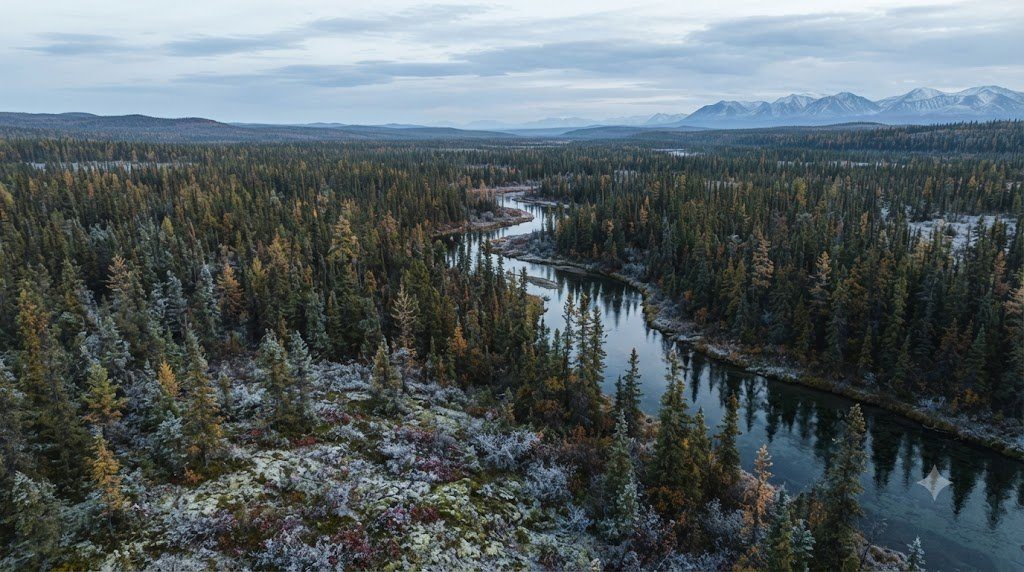
The circumpolar boreal forest—conventionally known as the Taiga—represents the largest contiguous terrestrial biome on planet Earth, encircling the high northern latitudes across Russia (Siberia), Scandinavia, Canada, and Alaska. Spanning over 17 million square kilometers between the 50th and 70th northern parallels, the taiga is bounded to the north by freezing Arctic tundra and to the south by temperate grasslands and mixed woodlands. Characterized by brutal sub-zero winters where temperatures regularly plunge below -50°C for months, short, cool summers with long photoperiods, pervasive permafrost active layers, and nutrient-impoverished, highly acidic Podzol (Spodosol) soils, the taiga is dominated by cold-hardy, resinous evergreen conifers: Spruces (Picea), Pines (Pinus), Firs (Abies), and cold-deciduous Larches (Larix). Investigating coniferous needle morphology, resin biochemical defense, permafrost thaw dynamics, and crown fire ecology provides vital insights into northern circumpolar biome stability.
The Deciduous Larch (Larix) Paradox in Far Eastern Siberia
In the hyper-continental interior of northeastern Siberia (the Sakha Republic / Yakutia)—where winter temperatures drop to an unimaginable -68°C in Verkhoyansk and Oymyakon—evergreen conifers like spruce and pine cannot survive. Instead, millions of square kilometers are dominated exclusively by Dahurian Larch (Larix gmelinii), a deciduous conifer. Retaining evergreen needles in Siberian hyper-cold is impossible because frozen soils prevent root water uptake while extreme winter cold desiccates foliage. Larches drop 100% of their needles in autumn, entering complete winter metabolic stasis with zero foliar surface area, allowing them to withstand the coldest temperatures inhabited by any tree on Earth.
1. Geographic Extent, Climate Envelopes, and the Subarctic Realm
The boreal biome is organized along distinct latitudinal sub-zones governed by temperature sums (growing degree days > 10°C) and winter minimums:
- Northern Taiga / Forest-Tundra Ecotone: Bordering the Arctic tundra, this sparse, open woodland features stunted, slow-growing conifers (often under 5 to 8 meters tall) growing on continuous permafrost. The growing season lasts fewer than 60 days, with winter lasting 8 to 9 months.
- Middle Taiga: The vast core of the boreal zone, featuring dense, closed-canopy coniferous forests dominated by Norway Spruce (Picea abies) and Scots Pine (Pinus sylvestris) in Eurasia, and Black Spruce (Picea mariana) and Jack Pine (Pinus banksiana) in North America.
- Southern Taiga: A transitional zone where conifers intermingle with cold-hardy broadleaf deciduous trees, including Trembling Aspen (Populus tremuloides), Paper Birch (Betula papyrifera), and Alder (Alnus), experiencing growing seasons of 90 to 120 days.
2. Coniferous Needle Anatomy: Biochemical and Physical Freezing Tolerance
Evergreen conifers thrive in the taiga through remarkable structural and physiological freezing adaptations:
Living parenchymal cells inside conifer needles survive freezing through extracellular ice nucleation. Rather than freezing internally (which punctures and destroys cell membranes), the cells actively dehydrate, pumping pure water across cell membranes into extracellular voids where it freezes harmlessly. High concentrations of soluble sugars (sucrose, raffinose) and antifreeze dehydrin proteins remain concentrated inside the cytoplasm, supercooling cellular sap down to -40°C without ice crystal formation.
3. Soil Pedogenesis: Podzolization and the Extreme Acidic Forest Floor
Taiga soils are universally classified as Podzols (Spodosols)—the most acidic, highly leached forest soils on the planet:
- The Acidic Mor Humus Horizon (O-Horizon): Conifer needles are packed with tough lignin, cellulose, waxes, and toxic polyphenolic tannins, with an exceptionally high carbon-to-nitrogen ratio ($C:N > 50:1$). This recalcitrant litter decomposes extremely slowly in cold temperatures, forming a thick, acidic (pH 3.2 to 4.2) raw humus blanket known as mor, completely devoid of earthworms.
- Chelation and the Ash-Grey Eluvial Horizon (E-Horizon): Organic acids leached from decomposing needles dissolve iron ($Fe$) and aluminum ($Al$) minerals. These organic chelate complexes leach downward with snowmelt, stripping all coloring agents from the mineral soil, leaving behind a stark, ash-grey, bleached silica sand horizon (the albic horizon, from the Russian zola meaning ‘ash’).
- The Dark Illuvial B-Horizon (Spodic Horizon): Deeper in the soil profile (30 to 60 cm), the downward-moving chelates precipitate, forming a dark reddish-black cemented layer enriched with illuvial organic carbon, iron oxides, and aluminum. This layer often forms an impermeable hardpan (ortstein) that impedes root growth and drainage.
4. Permafrost Dynamics: Continuous, Discontinuous, and Active Layers
Underlying large swathes of the northern boreal forest is permafrost—ground that remains at or below 0°C continuously for at least two consecutive years:
The ‘Drunken Forest’ (Thermokarst Subsidence)
Trees growing on permafrost are confined to rooting in the thin, seasonal active layer (30 to 100 cm deep) that thaws during summer. In areas underlain by ice-rich permafrost (yedoma), climate warming melts subterranean ice wedges, causing the ground to buckle, fissure, and collapse into thermokarst craters. Black spruce trees lose their structural root anchoring and tilt in erratic directions at wild angles, forming eerie geological phenomena known as ‘Drunken Forests’.
Permafrost prevents downward water percolation, creating waterlogged conditions on the surface even in regions receiving under 300 mm of annual precipitation. This moisture fuels expansive boreal peatlands, muskegs, and shallow braided river basins across northern Canada and Siberia.
5. Wildfire Regimes: High-Intensity Crown Fires and Serotiny
Wildfire is the supreme ecological rejuvenating disturbance of the taiga biome, operating on natural return intervals of 50 to 150 years:
Unlike temperate oak forests where low-intensity surface fires creep across the ground, boreal fires frequently develop into catastrophic, high-intensity stand-replacing crown fires. Driven by dry summer winds, volatile needle terpenes, and continuous ladder fuels (lichens, low spruce branches, moss thatch), fire fronts leap from treetop to treetop, burning millions of hectares in single fire seasons. Jack Pine (Pinus banksiana) and Black Spruce (Picea mariana) evolved serotinous cones sealed with heavy resin. The cones remain closed on living trees for decades; only the extreme heat of a crown fire (exceeding 60°C to 80°C) melts the resin, releasing millions of seeds immediately onto the freshly sterilized, mineral-rich ash bed to establish dense new forest cohorts.
6. Trophic Cascades: The Lynx-Hare 10-Year Population Cycle
The boreal forest provides the classic textbook example of cyclic predator-prey dynamics in animal ecology:
The Canadian Lynx (Lynx canadensis) is an obligate specialist predator of the Snowshoe Hare (Lepus americanus), which accounts for 80% to 95% of the cat’s winter diet. Every 9 to 11 years, snowshoe hare populations undergo dramatic synchronized population booms (reaching up to 500 to 1,000 hares per square kilometer), followed by catastrophic crashes down to under 10 hares per square km. As hare numbers surge, lynx reproduce prolifically, raising large litters. When overbrowsed willow and birch forage and heavy predation drive hare populations to collapse, lynx experience near-total kitten mortality, and adult lynx populations crash with a 1- to 2-year lag behind the hare cycle.
7. Climate Change: The Arctic Amplification Feedback Loop
The circumpolar taiga is warming at more than twice the global average rate, triggering alarming positive climate feedback loops:
- Albedo Feedback & Shrubification: As snowmelt occurs earlier in spring, dark coniferous canopies absorb solar radiation that was previously reflected by bright white snow, warming local air masses. Furthermore, boreal shrubs are invading Arctic tundra, reducing regional albedo.
- Permafrost Carbon Release: Boreal and subarctic permafrost soils hold an estimated 1,400 to 1,600 gigatons of organic carbon. As the active layer deepens, microbial decomposition of ancient thawed organic matter releases massive plumes of carbon dioxide ($CO_2$) and methane ($CH_4$), threatening to turn the boreal biome into a major global net carbon emitter.
- Insect Outbreaks: Warmer winters fail to kill overwintering larvae of devastating forest pests—most notably the Spruce Beetle (Dendroctonus rufipennis) and Siberian Silk Moth—resulting in mega-infestations that kill millions of hectares of mature taiga conifers.
8. Ectomycorrhizal Fungi: The Subterranean Boreal Scavengers
Coniferous trees could not survive in the cold, acidic, nitrogen-starved soils of the taiga without obligate symbiotic relationships with specialized Ectomycorrhizal (ECM) Fungi (such as Suillus, Cortinarius, Paxillus, and Amanita):
- Hartig Net and Fungal Mantle: ECM fungal hyphae sheath fine conifer root tips in a dense cellular mantle, penetrating between cortical cells to form an extensive intercellular nutrient-exchange network known as the Hartig Net. Trees allocate up to 25% to 35% of their total photosynthetically fixed carbon directly to their fungal partners.
- Direct Organic Nitrogen Enzymatic Scavenging: Unlike temperate agricultural soils where nitrogen exists as inorganic nitrate ($NO_3^-$), over 95% of nitrogen in boreal podzols is locked in recalcitrant protein-polyphenol complexes and chitin. Specialized boreal ECM fungi secrete powerful extracellular proteases and chitinases that chemically break down these tough organic complexes, delivering bioavailable amino acids and organic nitrogen directly to conifer roots.
- Phosphorus Weathering via Organic Acid Exudation: Fungal hyphae exude low-molecular-weight organic acids (such as oxalate and citrate) that etch into solid mineral grains (feldspar and mica), dissolving insoluble mineral phosphorus and potassium and piping it directly into host conifers.
9. Peat Plateaus, Palsas, and Muskeg Wetland Systems
Interspersed throughout the vast boreal coniferous forests are immense wetland complexes known as muskegs and permafrost landforms known as palsas and peat plateaus:
In discontinuous permafrost zones, low mounds of peat rise 2 to 6 meters above the surrounding waterlogged bog, elevated by a permanent frozen core of segregated ice lenses. These elevated palsas provide rare dry nesting sites for migratory shorebirds and micro-refugia for stunted black spruces. However, warming subarctic temperatures are causing rapid thermokarst degradation: the internal ice cores melt, causing palsas to collapse into flooded collapse-scar fens dominated by water sedges and aquatic mosses, shifting the ecosystem’s carbon balance from a historical sink to an active emitter of biogenic greenhouse gases.
10. Frequently Asked Questions Regarding the Boreal Taiga
Q: What is the difference between taiga and boreal forest?
The terms are often used interchangeably, but ‘taiga’ originally described the northern, more open coniferous sub-zone near the tundra boundary, while ‘boreal forest’ refers to the entire continuous circumpolar forested biome.
Q: Why do evergreen conifers dominate the boreal zone instead of broadleaf deciduous trees?
Conifers keep their needles year-round, allowing them to initiate photosynthesis immediately upon spring thaw without wasting precious time and energy growing new leaves during the short 60- to 90-day growing season.
Q: What is a serotinous cone and why does it need fire?
Serotinous cones are tightly sealed with sticky resin. They require the intense radiant heat of a wildfire (60°C–80°C) to melt the resin and open the scales, releasing seeds onto nutrient-rich ash beds.
Q: Why are Podzol soils so acidic and ash-grey in color?
Acidic conifer needles produce organic acids that leach iron and aluminum minerals downward with snowmelt, stripping colors and leaving an ash-grey silica sand horizon (E-horizon) behind.
Q: What is a ‘Drunken Forest’?
A drunken forest occurs when ice-rich permafrost beneath a black spruce forest melts due to climate warming, causing the ground to collapse unevenly and tilting trees at wild, irregular angles.
Q: Why does the Dahurian Larch drop its needles in Siberia while other conifers are evergreen?
In northeastern Siberia, winter temperatures drop below -65°C. Retaining needles would cause fatal frost desiccation; dropping needles allows the larch to survive the world’s most extreme winter cold.
Q: How do conifer needles survive freezing without cell membranes bursting?
Cells dehydrate water across membranes into extracellular spaces where it freezes safely, while high concentrations of sugars and antifreeze proteins supercool the inside of the cell without ice crystal formation.
Q: What drives the 10-year Lynx and Snowshoe Hare population cycle?
The cycle is driven by the interaction between hare food supply (winter willow/birch browse) and intense lynx predation. As hares overbrowse food and lynx populations peak, hares crash, followed 1-2 years later by a lynx population crash.
Q: What role do ectomycorrhizal fungi play in taiga conifer survival?
They form dense sheaths around root tips and secrete specialized enzymes that break down tough organic protein complexes in acidic soils, delivering essential nitrogen and phosphorus directly to trees.
Q: What is a palsa mound in the subarctic peatlands?
A palsa is a low peat mound with a permanently frozen core of segregated ice. They provide dry permafrost islands in bogs, but are rapidly collapsing into flooded fens as Arctic climates warm.