High-altitude tropical montane grasslands and alpine plateaus—represented by the northern Andean Páramo of Colombia, Ecuador, and Venezuela, the central Andean Puna of Peru and Bolivia, the Afroalpine moorlands of Mount Kenya and Kilimanjaro, and the high-elevation tussock grasslands of the Tibetan Plateau—represent extraordinary evolutionary arenas perched between the upper continuous forest limit and the permanent nival snowline (typically 3,200 to 4,800 meters above sea level). These extreme ecosystems are characterized by a unique ‘summer every day and winter every night’ microclimatic regime, where solar radiation and intense ultraviolet flux during midday give way to bone-chilling sub-zero frost every single night of the year. Understanding the specialized giant-rosette caulescent morphology, hygroscopic tussock root hydrology, and profound watershed regulation provided by these high-altitude sponges is vital for safeguarding urban water supplies across South America and Central Asia.
The Giant Espeletia (Frailejón) Thermal Insulation Mechanism
In the wet tropical páramos of Colombia, the iconic giant caulescent rosette plant Espeletia (Frailejón) reaches heights of 2 to 6 meters. To survive nightly sub-zero freezing, the plant never sheds its dead leaves; instead, dried leaves form a dense, persistent mantle up to 20 cm thick around the living central stem. This dead leaf layer provides exceptional thermal insulation, preventing the vascular cambium and sap from freezing. Furthermore, the living apical bud is enveloped in a tight rosette of densely pubescent leaves covered in white velvet hairs that trap stagnant air and reflect destructive ultraviolet radiation.
1. Geographic Distribution and Climatic Envelopes
High-altitude montane grasslands are categorized by moisture availability, elevation, and atmospheric circulation dynamics:
- The Wet Northern Andean Páramo: Spanning Venezuela, Colombia, and Ecuador between 3,000 and 4,800 meters elevation. Dominated by continuous cloud cover, fog drip, high relative humidity (often exceeding 90%), and annual precipitation ranging from 1,200 to 2,500 mm. Soils are organic-rich, volcanic ash Andosols that remain perpetually saturated with cold water.
- The Dry Central Andean Puna: Spanning Peru, Bolivia, and northern Argentina on the vast Altiplano plateau (3,800 to 4,500 meters). Characterized by severe seasonal aridity (precipitation 200 to 800 mm), intense solar insolation, and saline terminal lakes (Lake Titicaca, Salar de Uyuni). Dominants include stiff, silica-rich tussock grasses (Jarava ichu, Festuca dolichophylla) and resinous tola shrubs (Parastrephia lepidophylla).
- Afroalpine Moorlands: High-altitude islands atop isolated volcanic massifs in East Africa (Mount Kenya, Kilimanjaro, Ruwenzori). Dominated by giant senecios (Dendrosenecio) and giant lobelias (Lobelia), adapted to extreme diurnally fluctuating equatorial alpine conditions.
2. Andean Soil Pedogenesis: Andosols and Giant Watershed Sponges
The ecological and socio-economic importance of the Andean páramo lies in its function as a natural planetary water tower, driven by unique volcanic Andosol soils:
Andosols originate from volcanic ash weathering under cold, perpetually wet conditions. They are rich in amorphous aluminosilicate minerals—specifically allophane and imogolite—which form intimate complexes with humic acids. This structure yields soil with remarkably low bulk density (often less than 0.6 g/cm³), immense total porosity (up to 80%), and an astonishing water retention capacity: páramo Andosols can hold up to 300% to 500% of their own dry weight in water. This sponge-like capacity slowly releases purified water during dry months, providing over 85% of the drinking water for millions of residents in major Andean metropolises, including Bogotá (Colombia) and Quito (Ecuador).
3. Plant Life Forms: Convergent Evolution at High Elevations
Across unrelated plant families on different continents, high-altitude montane environments have forged spectacular examples of convergent morphological evolution, yielding five distinct life forms:
- Giant Caulescent Rosettes (Espeletia in South America, Dendrosenecio in Africa): Evolved thick piths that store liquid water, persistent dead-leaf insulation around the stem, and parabolic leaf orientations that warm apical buds through concentrated solar reflection.
- Sclerophyllous Tussock Grasses (Calamagrostis, Festuca, Jarava): Form dense, tightly packed hummocks up to 1 meter in diameter. Dead leaf blades and roots accumulate inside the center of the tussock, creating a warm, insulated microclimate where living tillers stay 5°C to 10°C warmer than the surrounding freezing ambient air.
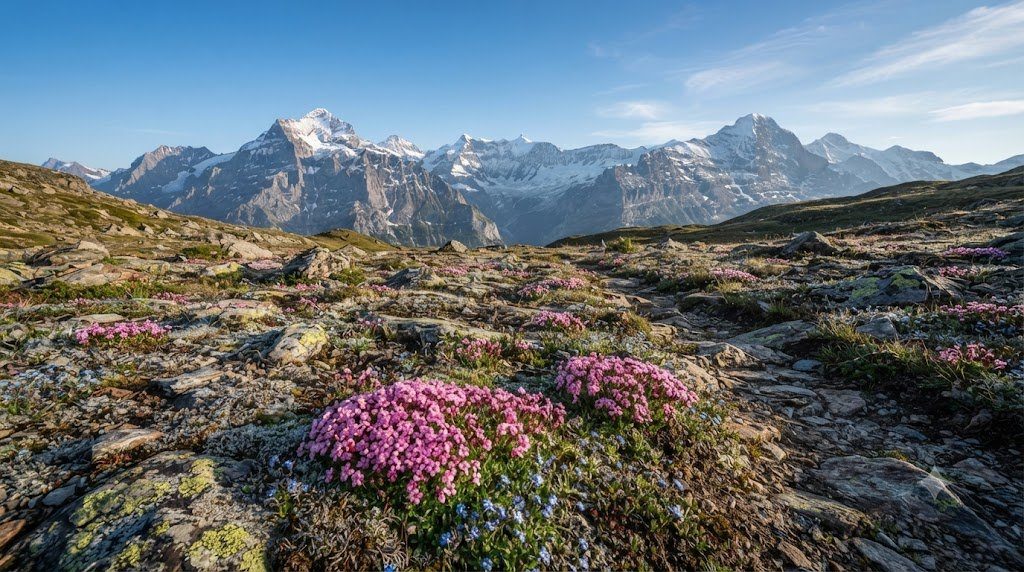
- Compact Cushion Plants (Azorella, Plantago rigida, Distichia): Grow as dense, rock-hard, ground-hugging domes consisting of thousands of tiny rosettes packed tightly together. This aerodynamic shape eliminates wind chill, absorbs ground heat, and creates moist interior microclimates that trap organic debris.
- Sclerophyllous Dwarf Trees (Polylepis): The highest-growing angiosperm trees on Earth, forming isolated groves at elevations exceeding 4,500 meters. Known as ‘Queñua’, Polylepis trees feature thick, multi-layered reddish papery bark that peels off in sheets, providing thermal insulation against freezing mountain winds.
- Geophytic Underground Cryptophytes: Maintain bulbs, tubers, and rhizomes insulated beneath the soil surface, producing small ephemeral leaves and flowers that hug the warm soil boundary layer.
4. Wildlife Ecology: Camelids, Raptors, and Thermal Physiology
Faunal communities in montane grasslands must cope with low atmospheric oxygen partial pressure ($pO_2$), freezing nocturnal cold, and high UV radiation:
The High-Oxygen Affinity of Andean Camelid Hemoglobin
Native Andean camelids—the wild Vicuña (Vicugna vicugna), wild Guanaco (Lama guanicoe), domestic Llama (Lama glama), and Alpaca (Vicugna pacos)—possess unique physiological adaptations to survive hypoxia above 4,000 meters. Their red blood cells are small, oval-shaped (elliptical), and present in exceptionally high concentrations (up to 14 to 19 million cells per microliter of blood). Furthermore, their hemoglobin exhibits an extraordinarily high affinity for oxygen ($P_{{50}}$ of just 18 to 22 mmHg, compared to 27 mmHg in humans), allowing them to extract oxygen efficiently from thin mountain air.
Predatory apex birds include the iconic Andean Condor (Vultur gryphus), which utilizes powerful thermal updrafts along steep mountain canyons to soar across vast territories scavenging on dead camelids and cattle, alongside the Spectacled Bear (Tremarctos ornatus), which browses on the succulent fibrous leaf bases of Puya bromeliads in the sub-páramo.
5. Anthropogenic Threats: Mining, Cattle Grazing, and Potato Agriculture
Despite their severe climatic conditions, montane grasslands face severe degradation from expanding human activities:
6. Climate Change and the Escalator to Extinction
Because montane grasslands occupy the very summits of tropical mountain ranges, they are uniquely vulnerable to the ecological phenomenon termed the ‘Escalator to Extinction’:
As global atmospheric temperatures rise, lower-elevation montane cloud forests and sub-páramo shrubs expand upward into higher elevations. Alpine plants and specialized endemics that already occupy the highest peaks (super-páramo) have nowhere higher to migrate. As thermal envelopes push past mountain summits, these narrow-range endemics face complete habitat loss and extinction. Furthermore, warming temperatures accelerate the microbial decomposition of deep soil organic carbon pools, transforming these ancient carbon sinks into net carbon sources.
7. Andean Peatlands (Bofedales): Glacial Water Filtration and Sponge Dynamics
Embedded within the high Andean puna and páramo are unique high-altitude peatland wetlands known locally as Bofedales. Dominated by compact, hard cushion-forming plants from the Juncaceae family—specifically Distichia muscoides and Oxychloe andina—bofedales represent vital green oases in otherwise hyper-arid or rocky alpine landscapes:
- Hydro-Ecological Function: Fed by glacial meltwater streams, subterranean springs, and seasonal runoff, bofedales act as colossal natural water purifiers and discharge regulators. The dense peat layer, often reaching 2 to 5 meters in depth, filters out glacial sediment, regulates stream pH, and maintains steady, perennial baseflows to downstream communities even during extended 6-month dry seasons.
- Forage Islands for Pastoral Livelihoods: In the hyper-arid Altiplano where surrounding bunchgrasses become coarse and silica-laden, bofedales provide lush, green, highly nutritious protein-rich forage year-round. They serve as the foundational grazing pastures for domestic alpacas and llamas, managed for centuries by indigenous Aymara and Quechua pastoralists through complex ancestral flood irrigation canal systems known as chakitaclla ditch networks.
- Vulnerability to Peat Extraction and Glacier Retreat: As tropical Andean glaciers retreat rapidly under climate warming, the primary perennial meltwater sources sustaining bofedales are dwindling. Furthermore, illegal harvesting of dried Distichia peat mats (champas) for commercial fuel and horticultural potting soil severely degrades these ancient hydrological sponges, releasing centuries of stored subterranean carbon into the atmosphere.
8. Periglacial Geomorphology: Solifluction, Needle Ice, and Patterned Ground
Above 4,000 meters in the super-páramo and high puna, the physical landscape is governed by dynamic periglacial geomorphic processes driven by relentless diurnal freeze-thaw cycles:
When surface temperatures drop below 0°C at dusk, soil pore water freezes and draws liquid moisture upward via capillary action, forming vertical ice crystals known as needle ice (pipkrake) that reach 2 to 6 cm in length. By dawn, these ice needles heave the uppermost layer of soil and unanchored plant seedlings into the air. When the morning sun melts the ice, the loosened soil collapses, often shearing off fragile taproots and leaving seedlings desiccated on the surface. Only plants with specialized elastic taproots or broad, flexible fibrous roots can survive this intense mechanical soil churning (cryoturbation). Over time, these daily freeze-thaw cycles sort stones and fine sediments into striking geometric geometric formations across the terrain, including stone polygons, sorted stripes, and solifluction lobes along sloping mountain contours.
9. Legal Protection and Watershed Conservation Alliances
Recognizing that the destruction of páramos directly jeopardizes national drinking water security, Andean nations have pioneered progressive legal frameworks:
In 2016, Colombia’s Constitutional Court issued landmark rulings strictly banning all mining, hydrocarbon extraction, and agricultural expansion within legally delimited páramo boundaries. Groundbreaking payment for ecosystem services (PES) programs, such as the Water Protection Fund (FONAG) in Quito, channel small surcharges from municipal water utility bills directly into compensation for high-altitude rural communities who commit to retiring livestock from sensitive watersheds and safeguarding pristine tussock grasslands.
10. Frequently Asked Questions Regarding Montane Grasslands
Q: Why are Andean páramos often described as ‘water towers’?
Páramos feature volcanic Andosol soils and peat bogs with up to 80% porosity that capture fog and rain, holding several times their weight in water and steadily releasing clean drinking water downstream throughout the year.
Q: What is the difference between Páramo and Puna?
Páramo is located in the northern Andes (Colombia/Ecuador) and is perpetually humid, wet, and misty. Puna is located in the central/southern Andes (Peru/Bolivia) and is much drier, rockier, and sunnier, subject to severe seasonal droughts.
Q: How do giant Espeletia plants survive nightly freezing temperatures?
They retain a thick mantle of dead dried leaves along their central trunk for thermal insulation, while their terminal apical buds are protected by dense, velvet-haired leaves that fold closed at night to trap warm air.
Q: Why are Polylepis forests biologically remarkable?
Polylepis (Queñua) trees grow at higher elevations than any other flowering tree species on Earth (up to 4,800 meters), surviving sub-zero winds through multi-layered, papery exfoliating bark.
Q: Why is planting pine trees harmful to páramo ecosystems?
Commercial pines (Pinus patula) are not native to the páramo. Their rapid growth and deep root systems extract huge amounts of water from volcanic soils, drying up natural bogs and drastically reducing downstream water flow.
Q: How do Andean camelids thrive in thin high-altitude air?
Camelids possess small, oval-shaped red blood cells in very high concentrations, along with specialized hemoglobin that binds oxygen with significantly higher affinity than other mammals.
Q: What is the ‘super-páramo’ zone?
The super-páramo is the highest, coldest vegetative zone (4,200 to 4,800 meters) immediately below the snowline, characterized by bare scree, extreme freeze-thaw cycles, and ground-hugging cushion plants.
Q: How do cushion plants create favorable microclimates for other species?
Cushion plants grow in dense, aerodynamic domes that absorb ground heat and block freezing winds. Their interior remains moist and insulated, serving as ‘nurse plants’ where other delicate seedlings can germinate.
Q: What is a bofedal and why is it ecologically vital in the Andes?
A bofedal is a high-altitude Andean peat wetland dominated by hard cushion plants that captures glacial meltwater, purifies stream flow, stores carbon, and provides perennial green grazing forage for vicuñas and alpacas.
Q: What is needle ice (pipkrake) and how does it challenge alpine seedlings?
Needle ice forms when soil pore moisture freezes into slender vertical crystals that lift topsoil and seedlings. When morning sun melts the ice, the soil collapses, often severing delicate plant taproots through cryoturbation.